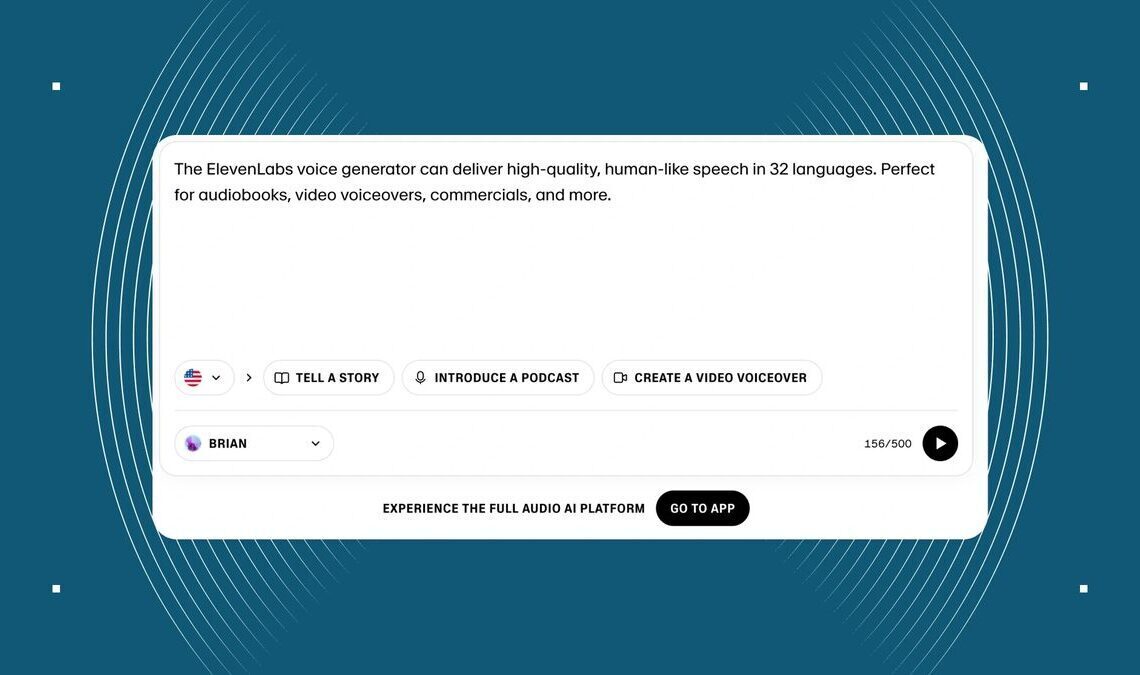

ElevenLabs has significantly expanded the language capabilities of its AI text-to-speech (TTS) model, now supporting a total of 70 languages. The New York City-based AI startup announced last week that the addition of 41 new languages makes their model accessible to approximately 90% of the global population.
The expansion was implemented on the Eleven V3 (alpha) model, which ElevenLabs launched on June 8th, touting it as their “most expressive TTS model.” The company made the announcement via their official X account, formerly known as Twitter.
The newly supported languages include a diverse range, such as Arabic, Assamese, Bengali, Bulgarian, Catalan, Gujarati, Latvian, Malay, Malayalam, Marathi, Nepali, Swahili, Tamil, and Telugu. This broadens the model’s utility for content creators and businesses aiming to reach wider audiences.


ElevenLabs advises users who wish to generate text in any of the new languages to record an Instant Voice Clone (IVC) while selecting the desired language. In addition, the company plans to add Voice Library voices for the newly supported languages in the coming weeks.
Eleven V3 builds upon the foundation of the multilingual V2 and V2.5 TTS models. A key feature of Eleven V3 is its support for inline audio tags, including “whispers,” “excited,” and “sighs.” These tags allow users to infuse emotional nuances and non-verbal cues into the generated audio, resulting in a more dramatic and engaging delivery.
Furthermore, the model supports multi-speaker interactions, complete with interruptions, natural pacing, and overlapping dialogues, creating a more realistic conversational experience. ElevenLabs emphasizes that Eleven V3 demonstrates improved handling of elements like stress, cadence, and contextual awareness.
The Eleven V3 model is currently accessible through the company’s website and mobile apps. However, it is not yet available as an application programming interface (API).
Prior to this language expansion, in April, ElevenLabs introduced Agent Transfer, a new enterprise-focused agentic feature designed for Conversational AI. This feature enables two AI agents to communicate with each other and seamlessly hand off conversations, along with relevant conversation data, to a more specialized agent.