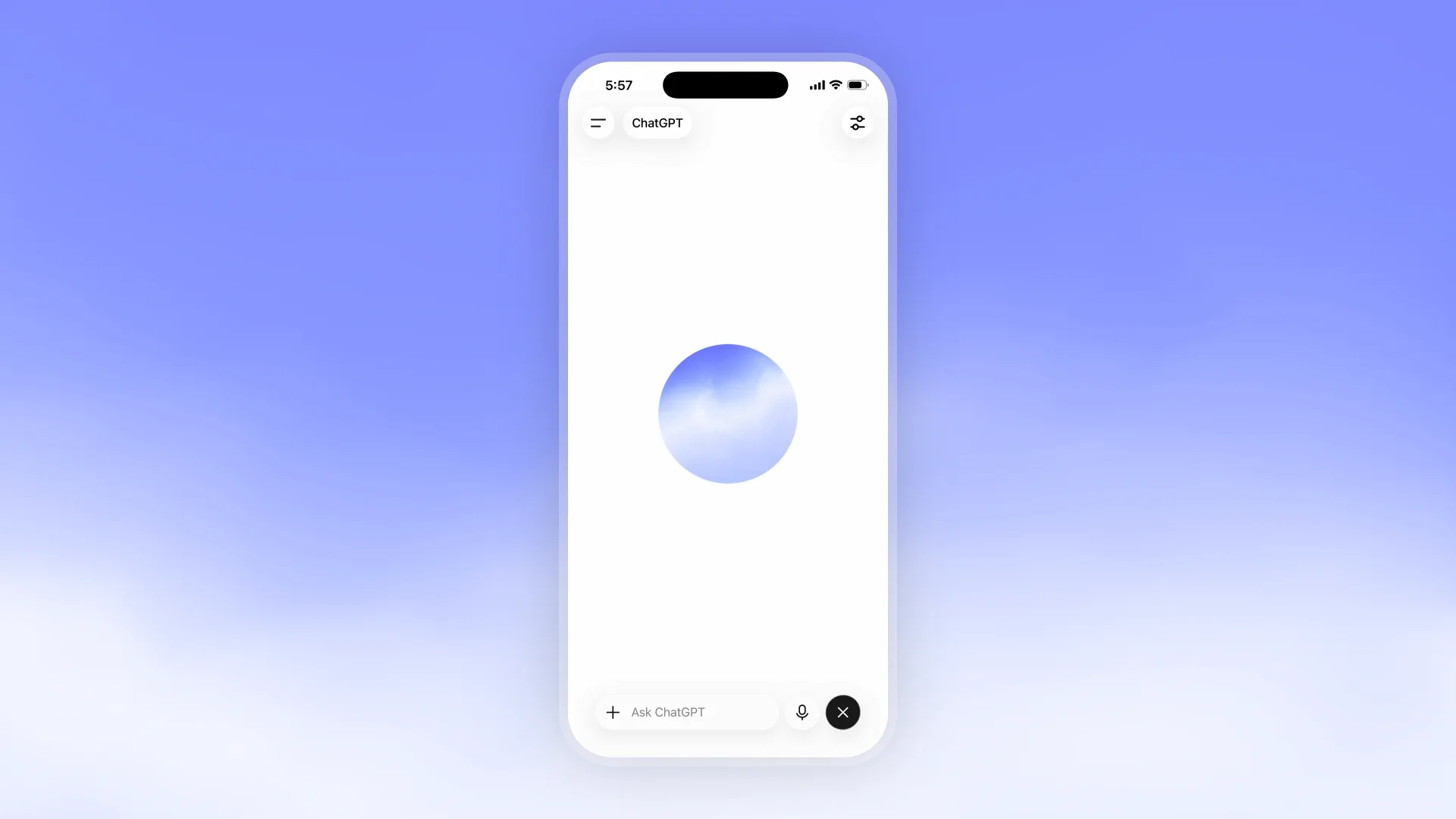

OpenAI launched GPT-Live on Wednesday, introducing two new voice models that replace the existing Advanced Voice Mode. The models, GPT-Live-1 and GPT-Live-1 mini, allow simultaneous listening and speaking, mimicking human conversation. GPT-Live-1 is the default for paid users on the Go, Plus, and Pro tiers, while GPT-Live-1 mini is for free-tier users.
The rollout begins globally on iOS, Android, and ChatGPT.com. OpenAI plans to integrate the models into its API for developers. GPT-Live represents the third generation of ChatGPT’s voice technology developed within two years.
The key feature of GPT-Live is a “full-duplex architecture,” enabling real-time audio processing while generating responses. “Instead of processing a sequence of separate messages, GPT-Live continuously processes input while generating output,” OpenAI said in a blog post. This allows for conversational acknowledgments like “mhmm” and avoids interruptions during exchanges.


The previous Advanced Voice Mode, launched in September 2024, operated on rigid turn-by-turn exchanges, creating frustrations in user experience. Background noise could trigger responses prematurely, affecting the flow of conversation.
GPT-Live also separates voice interaction from reasoning by delegating complex queries to a background model, namely GPT-5.5, while continuing the conversation seamlessly. “While it works, GPT-Live can keep talking with you and maintain the flow of conversation,” OpenAI explained.
ChatGPT’s original voice, launched in 2023, relied on a complex pipeline that introduced latency and lost information across models. This setup was refined in the Advanced Voice Mode, which attempted to streamline the process but still resulted in awkward pauses and interruptions.
OpenAI seeks to mitigate concerns from past controversies over voice impersonation, particularly stemming from the “Sky” voice resembling actress Scarlett Johansson’s. The company emphasized that GPT-Live avoids impersonation and incorporates safeguards against imitating real people’s voices.
Currently, over 150 million users interact with ChatGPT’s voice features weekly, part of a total of 900 million active users. With GPT-Live, users can access rich visual cards and choose between three response reasoning levels: Instant, Medium, and High. The system also promises improved performance in managing background noise and user interruptions during conversations.
Safety measures have evolved alongside the new models. OpenAI conducted extensive evaluations, demonstrating GPT-Live’s enhanced performance in categories including self-harm and hate speech, addressing unique risks associated with real-time voice interactions.
While OpenAI advances its voice technology, competitors like Google, ByteDance, and Nvidia have also recently launched their own full-duplex systems. GPT-Live currently lacks certain features such as video interaction or screen sharing, which are becoming standard in voice AI offerings.
Overall, GPT-Live represents a significant advancement for OpenAI as it positions voice as a primary interaction layer for artificial intelligence, aiming for more natural and agentic capabilities in AI communication.