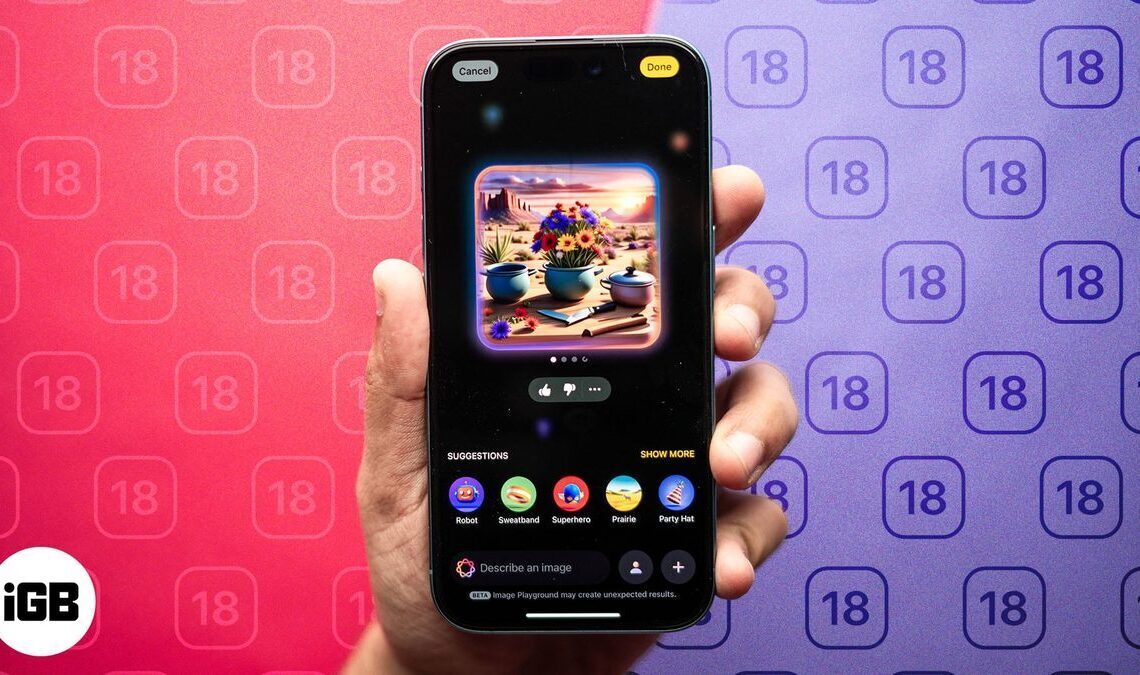

Apple’s proprietary image generation application, Image Playground, initially launched last year, is set to receive a monumental upgrade with the advent of iOS 26. This forthcoming operating system update, slated for release, promises to dramatically refine the app’s algorithms, pushing the boundaries of AI-generated imagery and user interaction. While Image Playground in its iOS 18 iteration often produced admittedly cartoonish results, iOS 26 aims to elevate its capabilities to a new echelon of realism and stylistic versatility, making it an indispensable tool for a wide array of users.
The core of these improvements lies in the enhanced realism of generated images, particularly those depicting people. In iOS 26, figures within Image Playground’s creations will exhibit a far more natural appearance, characterized by more lifelike eyes and significantly greater variation in hair texture and style, more closely mirroring real-world photographs. This addresses a key limitation of the previous version, where human representations often appeared somewhat generic or uncanny.
Image Playground, at its foundation, allows users to input text prompts to generate images across three distinct non-realistic styles. It also offers the convenience of selecting pre-determined scenes and props suggested by Apple, alongside the unique capability to generate images featuring personal friends and family. It is precisely within these personalized image generations that the most striking differences will be observed in iOS 26, as the algorithms for human-centric content have undergone substantial refinement.

Delving into the specific stylistic improvements, the “Animation” style in iOS 26 showcases a remarkable evolution. Previously, in iOS 18, images generated using this style often featured blunt, undifferentiated hair, high contrast, and somewhat unnatural facial expressions. However, with iOS 26, the Animation style introduces softer facial features, significantly more varied and flowing hair, and a more natural drape to clothing, though the app typically does not attempt to match specific outfits from source material. Furthermore, the Animation style in iOS 26 appears to take greater artistic license with backgrounds, character poses, and body shapes, demonstrating an improved ability to capture nuanced details such as specific eyebrow contours, adding a layer of sophisticated artistry to its output.
The “Sketch” style also benefits immensely from the algorithmic overhaul. In iOS 26, Image Playground’s Sketch style demonstrates a superior capacity for accurately matching facial expressions, distinctive features, and hair styles, resulting in generated images that bear a much closer resemblance to the intended subjects. This refinement is crucial for users seeking to create stylized yet recognizable representations of individuals.
Similarly, the “Illustration” style in iOS 26 shares many of the enhancements seen in Sketch. It excels at capturing and reproducing colors with greater fidelity and inventiveness, while also generating more imaginative and contextually relevant backgrounds. These improvements collectively contribute to a more polished and visually appealing output across all three built-in styles.
Beyond human subjects, the transformative changes within Image Playground extend to a broader spectrum of generated content. Improvements are demonstrably visible in images of animals, food items, landscapes, and various other subjects, across all three pre-existing styles. This broad applicability ensures that the enhanced algorithms benefit a wide range of creative endeavors within the app.
A particularly nuanced and significant advancement in iOS 26’s Image Playground is its improved ability to reflect emotion. The system now appears to better interpret and convey emotional states within generated faces. Even when a modifier like “sobbing” is applied, while not always manifesting literal tears, the generated face in iOS 26 exhibits a palpably greater sense of emotion compared to its iOS 18 counterpart. Further enhancing this capability, a dedicated “Expressions” menu has been integrated, offering users explicit options such as “laugh,” “happy,” “mad,” “sad,” “shocked,” “thinking,” “thumbs up,” and “thumbs down,” providing granular control over emotional depiction.
Perhaps one of the most groundbreaking additions to Image Playground in iOS 26 is the seamless integration of ChatGPT’s image generation capabilities. This strategic partnership dramatically expands the stylistic range available to users. Image Playground will now offer several suggested options leveraging ChatGPT’s prowess, including “anime,” “oil painting,” “vector,” “print,” and “watercolor” styles. These styles are generated using ChatGPT’s underlying powerful models rather than Apple’s native image generation technology. The output from these ChatGPT-powered styles is remarkably similar to what one might achieve directly using ChatGPT 4o for image generation, enabling the creation of popular and aesthetically pleasing anime-style images that have proliferated across the internet.
Furthermore, the ChatGPT integration introduces an open-ended “Any Style” option, providing unprecedented creative freedom. This feature allows users to prompt ChatGPT to mimic virtually any artistic style imaginable, pushing the boundaries of what’s possible within Image Playground. Crucially, ChatGPT’s capabilities also extend to generating realistic images, a significant departure from Apple’s native image generation technology which historically focused on non-realistic, stylized outputs. This means users can now, for instance, request a “realistic” image of a complex scenario, such as “a bird on top of a cat’s head,” and receive a photorealistic rendition.
The process for creating images with ChatGPT within Image Playground mirrors the standard Image Playground functionality: users can make a text-based request or upload an existing image to serve as the basis for the generation. The flexibility to combine uploaded images with text-based descriptions further enhances creative control. However, it is important to note that generating images using ChatGPT consumes “tokens.” For users with a free ChatGPT account, this typically restricts them to generating only one or two images. Accessing more extensive ChatGPT image creation features within Image Playground will necessitate a paid ChatGPT account, indicating a tiered access model for this advanced functionality.
Another significant integration in iOS 26 involves Image Playground’s role in the creation of “Genmoji.” In iOS 18, Genmoji was a separate feature exclusively located within the Messages app, with no direct support from Image Playground. With iOS 26, Image Playground now fully supports Genmoji creation. Genmoji can be selected as a distinct style within Image Playground, which then opens a dedicated interface allowing users to select single or multiple emojis for customization. A notable new Genmoji feature in iOS 26 is the ability to combine existing emojis to create entirely novel ones, rather than simply starting from scratch with a character. This innovative capability is accessible within Image Playground, in addition to its presence in the Messages app. Users can tap multiple emojis to produce a new combined emoji or select an emoji and then add text-based descriptions to fine-tune its appearance. Currently, there is no option to use personal photos as a basis for Genmoji. Once created, these personalized Genmoji are seamlessly added to the user’s emoji keyboard, ready for use within the Messages app.
Finally, to ensure transparency regarding the origin of generated content, iOS 26 implements a clear labeling system. When an image created using Image Playground in iOS 26 is shared, for instance, via AirDrop, it will be explicitly labeled as a “generated image” within its file name. This ensures that recipients are aware that the image is AI-created, promoting responsible use and clear communication.
In summary, iOS 26 marks a pivotal moment for Apple’s Image Playground, transforming it from a niche tool into a sophisticated and versatile platform for AI-generated imagery. The extensive algorithmic improvements, particularly for human and emotional rendering, coupled with the groundbreaking integration of ChatGPT and enhanced Genmoji creation, position Image Playground as a leading application in the evolving landscape of creative AI, offering users unprecedented artistic freedom and powerful new ways to express themselves visually.