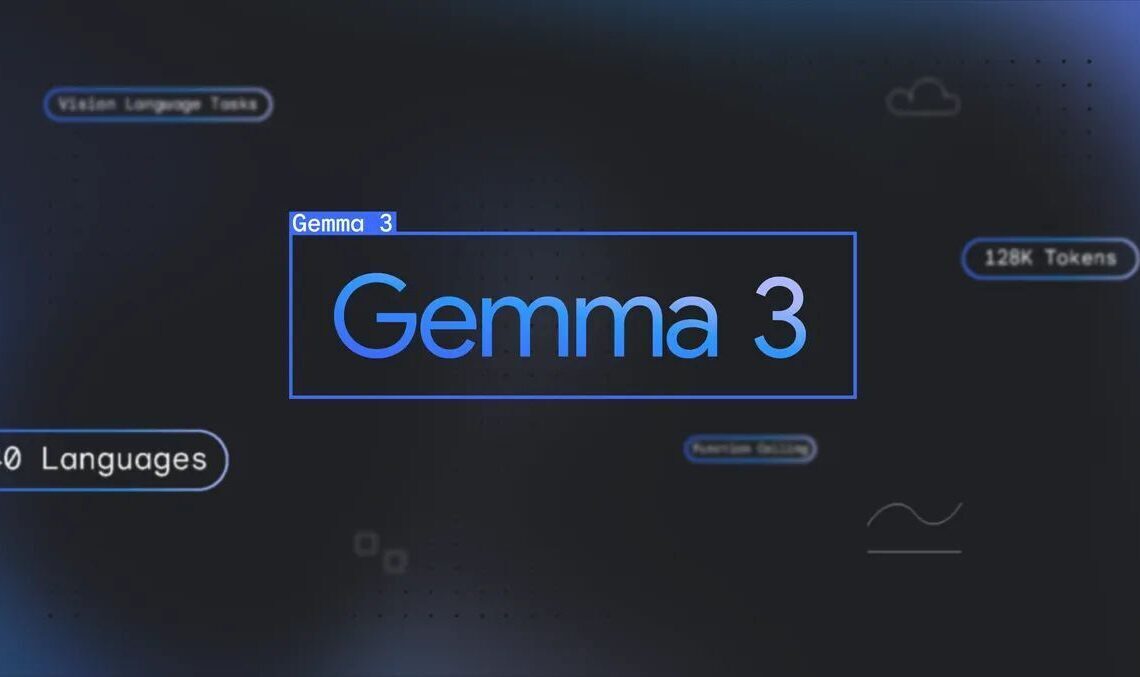

Google has announced the release of Gemma 3, a new family of open AI models crafted for developers, capable of operating on various devices, including phones and workstations, and supporting over 35 languages.
Introducing Gemma 3
Gemma 3 features upgrades over previous models, highlighting its position as the “world’s best single-accelerator model,” outperforming competitors such as Facebook’s Llama, DeepSeek, and OpenAI. It is designed to run efficiently on Nvidia GPUs and dedicated AI hardware, with enhanced capabilities for analyzing text, images, and short videos. The new vision encoder supports high-resolution and non-square images.
Gemma 3 is available in sizes of 1B, 4B, 12B, and 27B, allowing developers to select a model tailored to their hardware and performance requirements. It includes a 128k-token context window, enabling applications to process large amounts of data. The model also supports function calling and structured output for AI-driven workflows, along with quantized versions that reduce model size while maintaining accuracy.


In preliminary evaluations by LMArena, Gemma 3 delivered state-of-the-art performance compared to Llama-405B, DeepSeek-V3, and o3-mini, facilitating engaging user experiences on single GPU or TPU hosts.

According to Google’s technical report, despite concerns regarding potential misuse of AI technology, specific evaluations of Gemma 3’s enhanced STEM performance indicated a low risk level for creating harmful substances.
Google has emphasized the importance of rigorous safety protocols in the development of Gemma 3. The model’s development included extensive data governance and alignment with safety policies. ShieldGemma 2, an upgraded image safety classifier, is also being introduced, providing developers with tools to filter potentially harmful content categorized as dangerous, sexually explicit, or violent.
Gemma 3 integrates seamlessly with popular development tools such as Hugging Face Transformers, Ollama, JAX, Keras, and more. Developers can access Gemma 3 through Google AI Studio or download it via Kaggle and Hugging Face.
Customization options enable users to fine-tune models to meet specific needs using platforms like Google Colab and Vertex AI. Multiple deployment options are offered, including Vertex AI, Cloud Run, and local environments, allowing flexibility in application integration.
The Gemmaverse, celebrating its first anniversary with over 100 million downloads and 60,000 community-created variants, provides a platform for innovation. The Gemma 3 Academic Program allows researchers to apply for $10,000 in Google Cloud credits to support AI research, with applications open for four weeks.
For detailed technical insights and a comprehensive overview of responsible practices, Google encourages interested parties to refer to the 26-page technical report on Gemma 3.
Featured image credit: Google