
Construction in Roblox is set to become much simpler, even for individuals who lack expertise in 3D design. Roblox revealed that they are introducing a new generative AI tool that enables users to generate complete 3D environments through the use of basic commands. This move could dramatically simplify the game creation process, and it’s making waves among developers.
How will AI shape Roblox’s games?
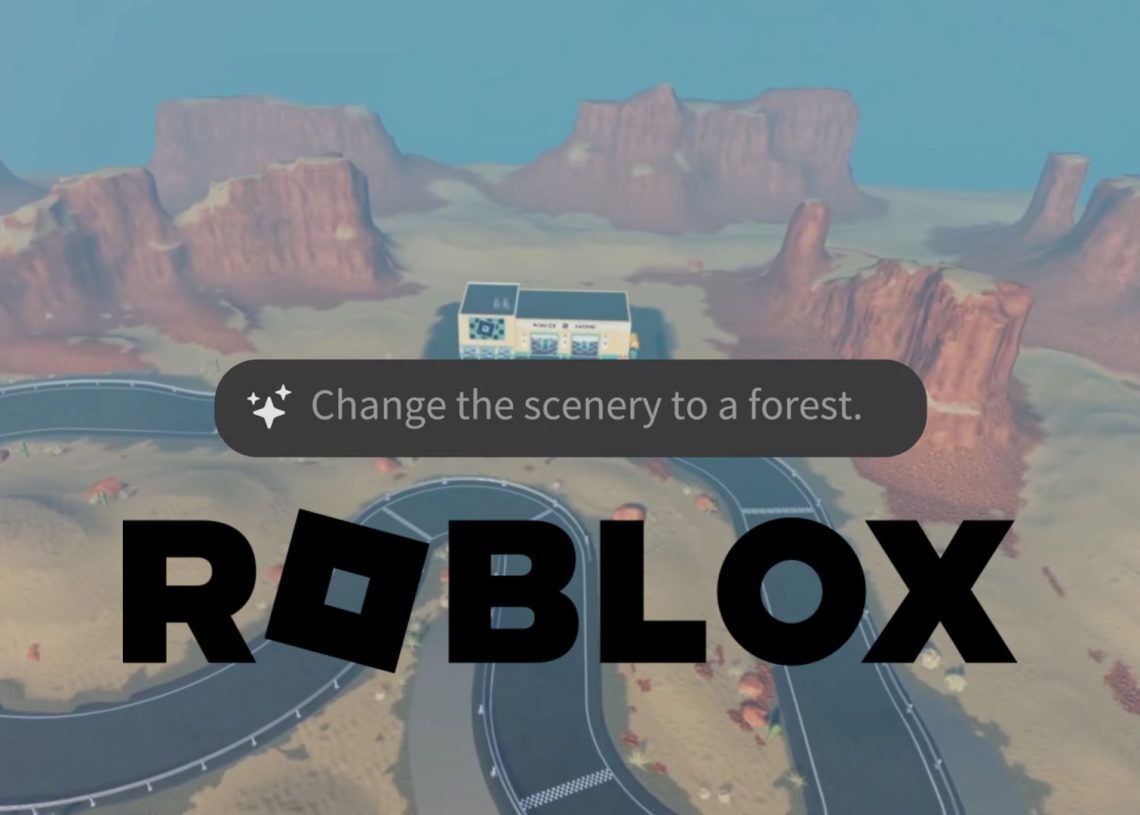
Roblox’s generative AI will soon enable creators to input commands like “Generate a race track in the desert,” and the system will create that environment in moments. This tool can enable even those with no design skills to create impressive game materials. While developers on Roblox already have tools to manually create scenes, this AI model will speed up the process, making it possible to build, modify, and expand scenes on the fly. Although the company has yet to specify when the tool will go live, excitement is building around its potential to change the game creation experience.


The most striking aspect of Roblox’s new tool is its ease of use. For example, a creator could write a prompt like “Change the desert to a forest” or “Switch from day to night,” and the AI would instantly modify the environment. This kind of flexibility is unprecedented in Roblox’s current setup. While experienced developers can already make these changes manually, this AI tool offers the same result with just a few keystrokes. According to Roblox, it won’t just be fast—it will also make it easier for creators with limited art skills to design more immersive and varied environments.
The excitement among the Roblox community is palpable. Game developers, like Marcus Holmström, CEO of The Gang, which builds popular Roblox games, are already praising the possibilities. He notes that the AI tool will allow developers to quickly experiment with different design ideas, such as testing out different types of mountains, without spending hours on manual creation. After the AI generates a design, creators can make final tweaks, ensuring the result is both efficient and personalized.
AI will put the building blocks in place
Roblox’s AI tool works fascinatingly, breaking down the 3D stuff into “blocks,” much like words in a language model. Each block is assigned a numerical value based on how likely it is to fit into the scene being built, similar to how large language models predict the next word in a sentence. Just as a language model predicts the next word in the sentence “The capital of France is …” as “Paris,” Roblox’s AI will predict which block should come next when creating 3D objects and environments.
However, building 3D environments comes with its challenges, primarily because there is far less data available for 3D environments compared to text. Roblox has had to use a mix of user-generated content from its community and external 3D data sets to train its models. Anupam Singh, who is the vice president of AI and growth engineering at Roblox, pointed out that the main challenge is locating top-notch 3D data. While language models require extensive text data for training, 3D models rely on data encompassing X, Y, and Z dimensions.
Despite these difficulties, Roblox’s AI appears to be tackling the problem in creative ways. For instance, one of the tool’s systems uses a second AI trained on 2D data to check if the 3D creations make sense visually. If something looks off—such as a tree appearing in the middle of a racetrack—the AI will rerun the process until it generates a more appropriate result.
Balancing AI and human creativity
Even with the rise of AI in game design, human involvement remains crucial. Chris Totten, an associate professor in Kent State University’s animation game design program, pointed out that AI-generated environments often lack the depth and creativity that make games engaging. While AI can generate landscapes, the hand of a skilled designer is still needed to craft something that responds to how players will interact with the game. This dynamic raises an interesting debate about what it means to create compelling, player-centered game areas in an age of AI.
Totten’s comparison of AI tools to students using AI to write essays highlights an important point: while AI can assist in the creative process, it cannot fully replace human thought and intuition. AI can create a base, but it is the responsibility of designers to transform this base into something that will be pleasurable for players. As AI tools become further incorporated into platforms like Roblox, the exploration of the balance between technology and creativity will persist.
Open source and open opportunities
Roblox’s decision to release its 3D foundation model as open source could have a big impact. By making the AI model accessible to other developers, including competitors, Roblox is encouraging innovation. Singh believes that making the model open source could lead to new advances in 3D environment creation.
This open-source strategy is useful for solo developers who lack the resources or expertise to create intricate Roblox. Holmström noted that many developers work solo, and this tool could enable them to take on bigger projects without needing to find a collaborator with specialized 3D design skills. For these creators, the generative AI tool could boost their creative freedom and productivity.
Where creativity meets automation
As Roblox adds AI to its platform, the company is already using AI in other ways. An AI model checks chat for bad language and warns or bans people who keep doing it. The 3D AI tool is part of a plan by Roblox to automate processes while still letting people be creative.
By mixing human talent with AI, Roblox’s new tool promises to make the creative process easier without taking away the artistic touch. While the technology is still being improved, it seems clear that the use of AI in Roblox will change how game environments are built, providing new opportunities for developers of all skill levels.
Featured image credit: Roblox / YouTube