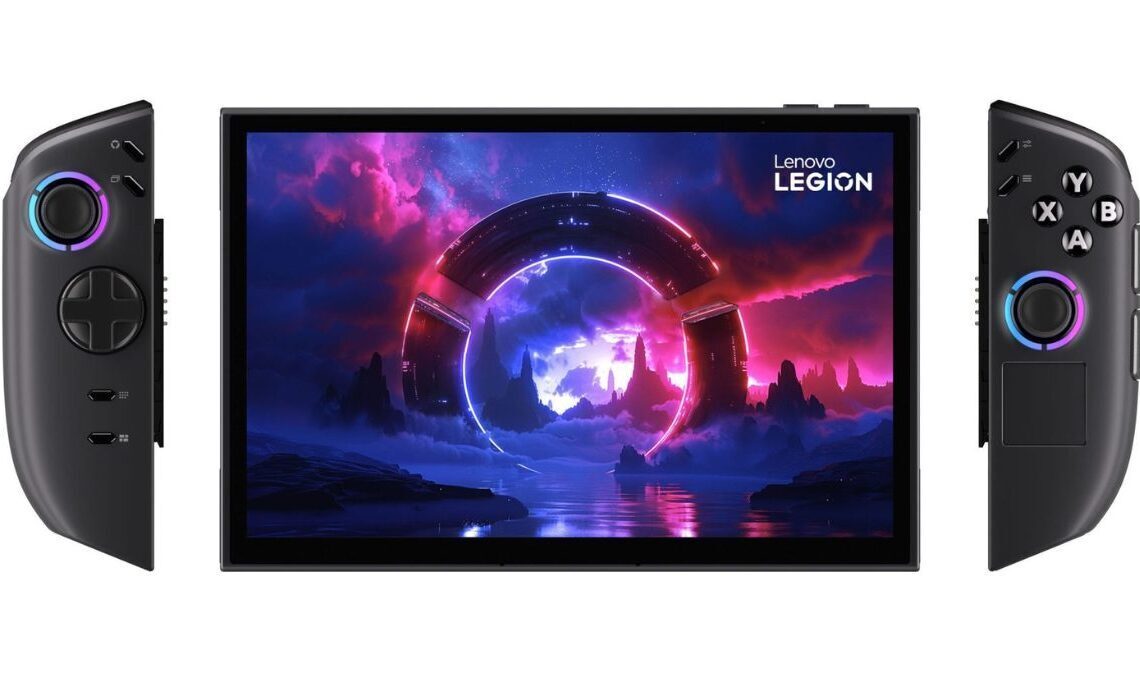

Lenovo has officially announced the Legion Go 2, the successor to its handheld gaming PC, the Legion Go. While the original Legion Go was considered polarizing, the new model aims to address user feedback with improvements in several key areas. However, these enhancements come at a higher price point, starting at $1,099, approximately $400 more than the original’s $699 launch price.
The Legion Go 2 features a design with detachable wireless controllers, similar to the Nintendo Switch, a built-in kickstand, and a hidden optical mouse. According to Lenovo, the controllers have been redesigned for improved comfort. They incorporate a pivot-point D-pad and Hall-effect joysticks, the latter of which is intended to resist drift. A lock-in mouse skate accessory is also included.
One of the most significant upgrades is the battery capacity, which has been increased by 50% from 49.2Wh to 74Wh. The Legion Go 2 also boasts an 8.8-inch OLED panel with a resolution of 1920×1200. This panel offers a variable refresh rate ranging from 30Hz to 144Hz, with a brightness of 500 nits and a peak brightness of 1,000 nits. In contrast, the original Legion Go featured a 2560×1600 IPS panel with a fixed refresh rate of 144Hz or 60Hz and no variable refresh rate (VRR) support.


The choice of a lower-resolution OLED panel should reduce the demand on the device’s processing capabilities, helping to deliver smoother frame rates. The Legion Go 2 is powered by either an AMD Ryzen Z2 or Z2 Extreme chip.
Here’s a comparison of the specifications between the Legion Go 2 and the original Legion Go:
Starting Price:
- Legion Go 2: $1,099
- Legion Go: $699
Screen:
- Legion Go 2: 8.8-inch 1920×1200 OLED with 30-144Hz VRR, 500-nit brightness (1000-nit peak)
- Legion Go: 8.8-inch 2560×1600 IPS at 144Hz or 60Hz, 500-nit brightness
Chip:
- Legion Go 2: AMD Ryzen Z2 or Z2 Extreme
- Legion Go: AMD Ryzen Z1 Extreme
Memory:
- Legion Go 2: 16GB LPDDR5X-7500 (Z2) or 32GB LPDDR5X-8000 (Z2E)
- Legion Go: 16GB LPDDR5X-7500
Battery:
- Legion Go 2: 74 watt-hour
- Legion Go: 49.2 watt-hour
Size (with pads):
- Legion Go 2: 11.64 x 5.38 x 1.66 inches (295.6 x 136.7 x 42.25mm)
- Legion Go: 11.76 x 5.16 x 1.6 inches (298.8 x 131 x 40.7mm)
Tablet Size:
- Legion Go 2: 8.11 x 5.38 x 0.9 inches (206 x 136.7 x 22.95mm)
- Legion Go: 8.27 x 5.16 x 0.79 inches (210 x 131 x 20.1mm)
Weight:
- Legion Go 2: 2.38 pounds (1079g)
- Legion Go: 1.88 pounds (854g)
Ports:
- Legion Go 2: USB4 x2, MicroSD UHS-II, 3.5mm headset
- Legion Go: USB4 x 2, MicroSD UHS-II, 3.5mm headset
AMD has confirmed that the Ryzen Z2 processor offers similar performance to the Z1 Extreme, while the Z2 Extreme provides a modest upgrade. The Legion Go 2 can briefly reach 35W in a custom turbo mode. North American models will come with 1TB of storage by default, with a 2TB option available on the highest-end configuration. All models except the entry-level SKU will feature 32GB of RAM. The power button now integrates a fingerprint reader.
The redesigned controllers are compatible with the original Legion Go. The pricing tiers for the Legion Go 2 are as follows:
- $1,099.99 (Z2, 16GB RAM, 1TB Storage)
- $1,199.99 (32GB RAM)
- $1,349.99 (Z2 Extreme, 32GB RAM, 1TB Storage)
- $1,479.99 (Z2 Extreme, 32GB RAM, 2TB Storage)
For budget-conscious buyers, Lenovo offers the $830 Legion Go S with SteamOS. However, there is no SteamOS version of the Legion Go 2 currently announced. The Legion Go 2 is slated to receive the Xbox full-screen experience in Spring 2026, aligning it with Asus’ Xbox Ally handheld. The Xbox full-screen experience for the Go 2 will launch in Spring 2026.