
Google Text-to-Speech is a cloud-based AI tool that converts written text into natural-sounding speech using Google’s advanced machine learning models. It supports over 380 voices across more than 75 languages and variants, making it suitable for global applications. The tool is designed for developers and businesses looking to enhance customer interactions or build voice user interfaces. Users can customize speech output with pitch, rate, and volume controls, and even create unique brand-specific voices. Integration is facilitated through a comprehensive API that supports various audio formats.
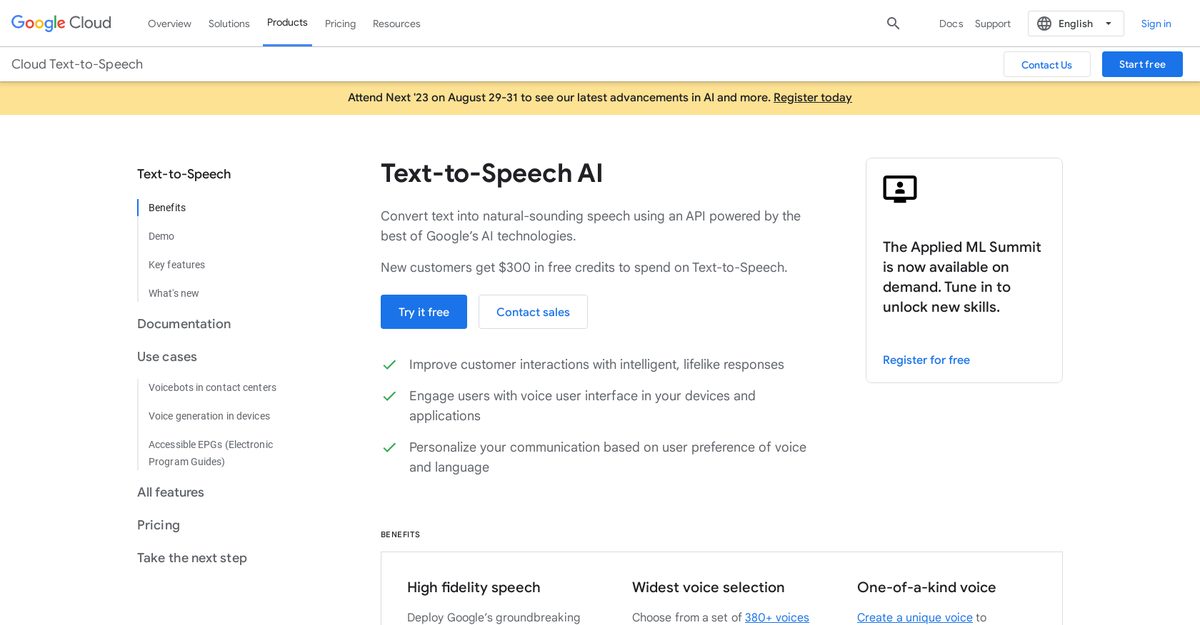
Google text to speech
Modality Text
Last UpdatedMarch 26, 2026
Pricingfree tier available: 0-4 million characters/month for standard voices, 0-1 million characters/month for wavenet voices. paid tiers start at $4 per million characters for standard voices and $16 for wavenet voices.
Overview
Pros & Cons
✓ Pros
- high-quality, natural-sounding speech generation
- wide selection of over 380 voices across 75+ languages
- ability to create unique, brand-specific voices
- flexible audio format options including mp3 and ogg opus
- comprehensive api documentation for easy integration
- supports pitch tuning, speaking rate adjustments, and volume control
- low-latency streaming for high-quality audio output
- instant custom voice creation feature
- detailed speech customization using ssml
- audio profiles optimized for various playback devices
✗ Cons
- pricing can be high for premium voices
- free tier has limited character allowance
- some users report occasional latency issues
- complexity in creating custom voices may deter some users
- dependence on internet connection for api access
- limited customization options for free tier users
- no offline functionality available
- can become costly with high usage due to character-based pricing
- requires familiarity with apis for integration
- voice availability may vary by language
Frequently Asked Questions
it supports over 380 voices across more than 75 languages and variants.
yes, users can adjust pitch, speaking rate, volume, and use ssml for detailed customization.
yes, the free tier includes up to 4 million characters per month for standard voices and 1 million for wavenet voices.
no, it requires an internet connection to access the api.
yes, the tool offers instant custom voice creation to develop unique brand-specific voices.
the tool supports multiple audio formats, including mp3 and ogg opus.
pricing is based on the number of characters processed, with different rates for standard and wavenet voices.
some users report occasional latency issues, but the service generally provides low-latency streaming.
yes, some familiarity with api integration is required to use the service effectively.
no, voice availability may vary depending on the language.