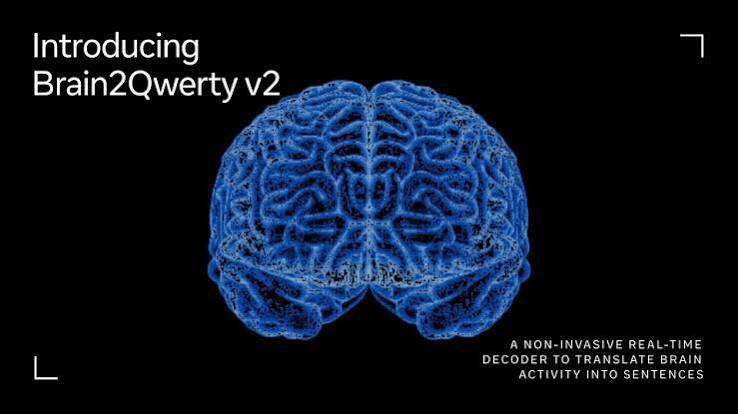

Meta unveiled Brain2Qwerty v2, a non-invasive brain-computer interface, which decodes typed sentences from raw neural signals in real time. The announcement coincided with the publication of the original Brain2Qwerty research in *Nature Neuroscience*. The company claims this system is the highest-performing of its kind.
Brain2Qwerty v2 achieves an average word accuracy of 61% across participants using magnetoencephalography (MEG). For the top-performing participant, accuracy reached 78%, with over half of sentences decoded containing one or fewer word errors.
The system was trained on approximately 22,000 sentences from nine volunteers, each recorded for 10 hours while wearing an MEG device and typing. The decoding pipeline uses end-to-end deep learning on raw brain signals combined with fine-tuned large language models, allowing the system to bridge what Meta described as the gap between noisy neural data and coherent language.



This updated system advances beyond the character-level decoding of its predecessor, focusing on decoding words and semantics directly. Meta stated that performance scales log-linearly with data volume, indicating potential for further improvement as more training data is used.
The 61% word accuracy marks a significant improvement from previous non-invasive methods. Brain2Qwerty v1, also published in *Nature Neuroscience* the same day, achieved a character error rate of 32% using MEG. Historically, high word-level accuracy in brain decoding has only been achievable through surgical implants, which carry risks such as infection and signal degradation over time.
Meta positioned this research as a potential solution for patients with brain lesions or neurological disorders affecting communication. “We believe this research has the potential to make a real difference for the millions of people who suffer from brain lesions or disorders that prevent them from communicating,” the company said.
To support further research, Meta released full training code for both Brain2Qwerty v1 and v2. The Basque Center on Cognition, Brain and Language also released the v1 dataset. Public reaction has been mixed, with some praising the technology for its accessibility and others expressing distrust regarding Meta’s involvement in brain-reading technology given the company’s business model focused on advertising.