
The rapid evolution of generative AI has fundamentally transformed digital media creation. Yet, as the industry matures, creators and developers are running into a clear structural wall: the single-model bottleneck. In the early waves of this technology, the industry focused on training massive, monolithic systems expected to handle every stage of production. Real-world deployment has made it clear that a single model cannot excel at everything. A system optimized for complex textual reasoning often lacks the spatial consistency required for high-fidelity illustration, while models designed for fluid video motion struggle with long-form narrative logic.
As a result, professional AI content creation is rapidly shifting from isolated, single-model generation to advanced, multi-model orchestration. Creators frequently find themselves jumping between separate tools, using one LLM for scripting, a diffusion model for storyboarding, and a third platform for video rendering. The primary challenge is no longer the raw capability of individual models, but the manual friction required to coordinate them.
Many observers expect the next major architectural leap to come from agentic orchestration pipelines.The OiiOii platform enters this space not as another standalone generator, but as a centralized AI animation platform. By functioning as an automated AI animation agent , OiiOii constructs a unified environment that connects specialized, engines — such as Gemini, GPT Image 2, Seedance 2.0, Sora2, and Kling 3.0 into a single, continuous creative workflow.


The multi-model production stack: Allocating specialized tasks
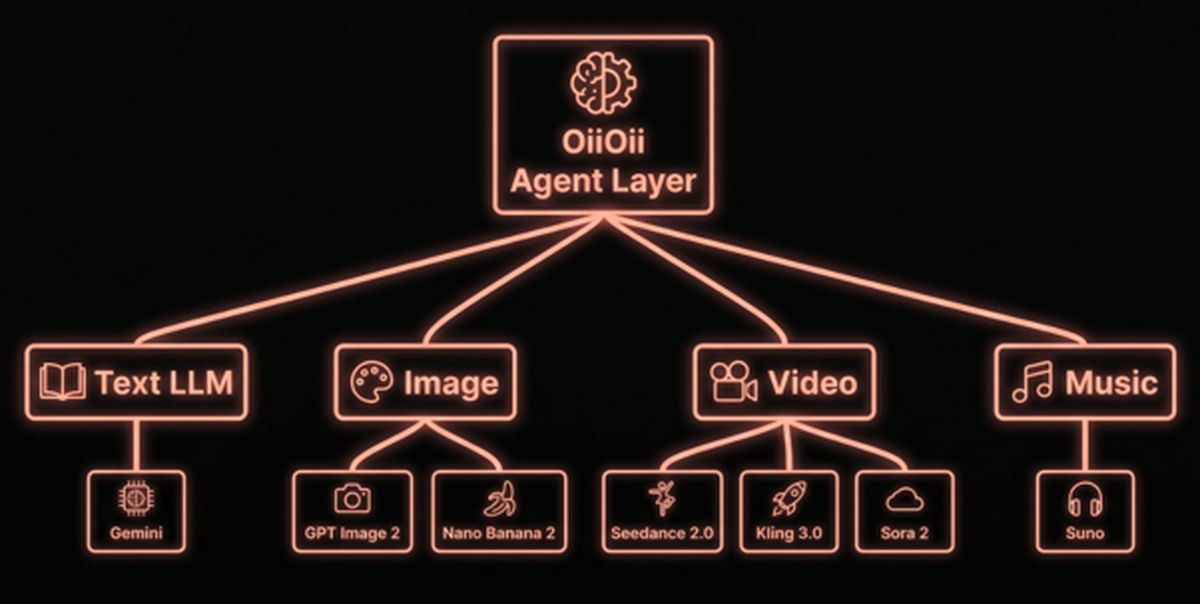
Instead of forcing a single generative engine to struggle through a complex multimedia pipeline, OiiOii’s underlying architecture acts like a digital studio director, distributing individual tasks to specific models based on their strengths.
1. Gemini: high‑context narrative logic
Long-form storytelling requires strong context retention and deep thematic reasoning. OiiOii leverages Gemini to manage the heavy text-based logic of the pipeline. The model handles script expansion, character dialogue, and structural story pacing. It also translates narrative concepts into complex, optimized prompt logic tailored for downstream visual generation.
2. GPT Image 2: spatial and visual asset consistency
Once the narrative blueprint is mapped, the workflow transitions to asset creation. GPT Image 2 is used for high-quality conceptual art, character turnarounds, and environmental keyframes. Its strength lies in decoding complex prompt instructions to deliver polished, visually coherent references that serve as the anchor for the project’s overall aesthetic.
3. Seedance 2.0, Sora2, and Kling 3.0: temporal motion and rendering
The final, computationally heavy stage requires translating static visual assets into fluid video. OiiOii integrates advanced motion engines like Seedance 2.0, alongside frameworks like Sora2 and Kling 3.0, to function as its rendering pipeline. These engines take the character designs and keyframes generated in earlier steps and handle the task of temporal consistency, transforming still concept art into high-fidelity animated clips.
Demystifying the agent layer: Solving asset drift
The key differentiator within OiiOii’s architecture is its intelligent Agent layer. In a traditional manual workflow, an animation studio or individual creator experiences significant “semantic drift” when moving between tools. For example, a character generated in an image tool will often look different when fed into a separate text-to-video or image-to-video engine.
OiiOii’s AI animation Agent bridges this gap by acting as a persistent data coordinator. It translates overall user intent into an interconnected series of backend tasks, carrying visual and narrative context across model boundaries. By locking in preset characters, utilizing strict scene references, and automatically refining prompt chains between generations, the Agent reduces the need for constant human intervention and manual troubleshooting.
The automated pipeline: from concept to render
For small businesses using video for marketing, indie animation studios, and independent digital creators, OiiOii condenses an otherwise fragmented development lifecycle into a single, automated AI animation workflow:
- Step 1 (Input): The creator enters a baseline creative concept, premise, or rough outline into the environment.
- Step 2 (Scripting): The agent uses Gemini to expand the concept into a structured script, segmenting the narrative into logical scene directions and shot lists.
- Step 3 (Storyboarding): The system passes the shot logic to GPT Image 2, automatically generating character sheets, backgrounds, and visual keyframes.
- Step 4 (Animation): Motion engines such as Seedance 2.0 ingest these visual assets and convert the static storyboards into dynamic video sequences.
- Step 5 (Assembly): The platform synthesizes the generated clips, pairs them with automated background music, and assembles a complete, structured animation sequence.
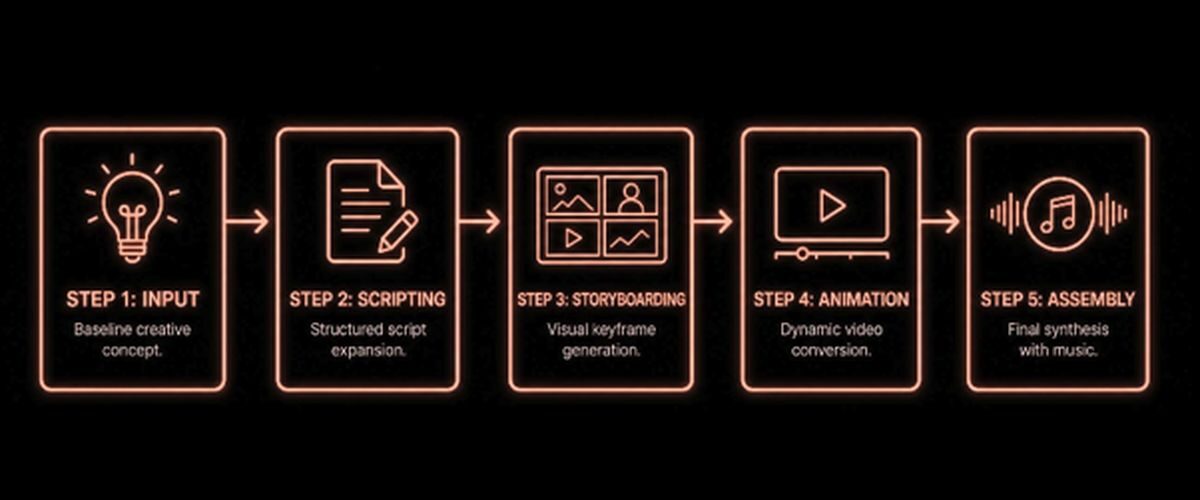
Throughout this process, the human creator functions as a director. They are freed from the technical burden of tool-switching and manual prompting, stepping in primarily to review, refine, or adjust specific shots when necessary.
Production efficiency and the creator ecosystem
Beyond software orchestration, pipeline efficiency also depends on infrastructure. OiiOii works closely with underlying model providers, giving active creators and small teams more predictable access than public API queues. This level of access can significantly reduce rendering wait times, making rapid prototyping and iterative editing more practical in everyday workflows.
To support this technical pipeline, the platform includes a collaborative community environment through OiiOii TV. Rather than operating as a closed, isolated enterprise utility, OiiOii TV functions as an internal content stream where global creators can share finished pieces, exchange pre-configured workflow templates, and study successful prompt architectures. This community layer lowers the barrier to entry, and turns advanced creative AI tools into a shared, accessible ecosystem.
Balancing automation with technical realities
To maintain an objective, industry-aware perspective, it is important to note that an automated agent workflow does not make human directors obsolete. Generative AI remains inherently unpredictable. When dealing with intricate character interactions, highly specific choreography, or complex narrative continuity, drift can still occur.
OiiOii does not claim to automate the human element out of AI video generation; instead, it reframes the software’s role. The platform functions as a highly competent, hyper-efficient production assistant, handling the tedious, fragmented work of model coordination while keeping the human artist firmly in control of the final creative vision.
Ultimately, OiiOii’s multi-model framework points toward the future of scalable digital media. By shifting the focus away from individual model capabilities and centering it on intelligent, agentic orchestration, it offers a glimpse of how modern, continuous, and accessible animation production can be built.
You can try OiiOii AI here: https://oiioii.ai/