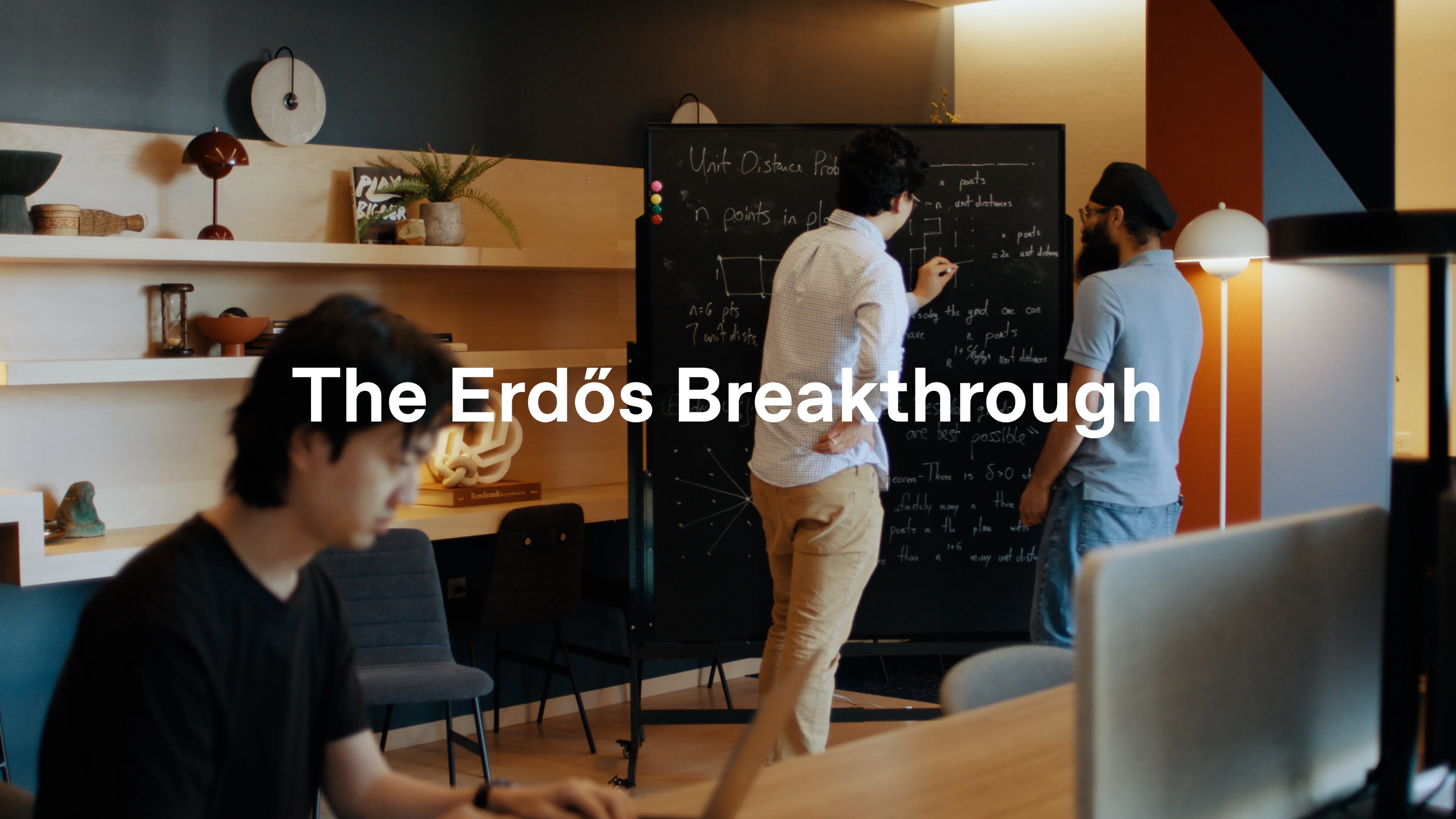

OpenAI announced that its new reasoning model has produced an original mathematical proof disproving a famous unsolved conjecture in geometry first posed by Paul Erdős in 1946. This achievement follows a controversial claim made by former OpenAI VP Kevin Weil seven months ago, when he stated on X that GPT-5 found solutions to ten previously unsolved Erdős problems, along with progress on eleven others. It was later clarified that GPT-5 had not actually solved those problems but had identified existing solutions in the literature.
Rivals in the AI field, including Yann LeCun and Google DeepMind CEO Demis Hassabis, criticized the earlier claim, prompting Weil to remove his post. OpenAI’s updated announcement included remarks from notable mathematicians such as Noga Alon, Melanie Wood, and Thomas Bloom, who supported the disproof and termed Weil’s earlier statements a “dramatic misrepresentation.”
OpenAI stated that for nearly 80 years, mathematicians believed the optimal solutions to the conjecture resembled square grids. The new model has reportedly discovered a completely new family of constructions that outperforms this long-held belief. This case marks the first instance of AI autonomously solving a significant open problem in mathematics, according to OpenAI.



The proof originated from a general-purpose reasoning model, rather than a system tailored for mathematics, highlighting the capability of AI to manage complex reasoning tasks and interconnect ideas across diverse fields. OpenAI emphasized the potential implications of this development for biology, physics, engineering, and medicine.
Mathematician Thomas Bloom remarked that AI is facilitating a deeper exploration of mathematics, questioning what other significant discoveries might lie ahead. “AI is helping us to more fully explore the cathedral of mathematics we have built over the centuries,” he said.