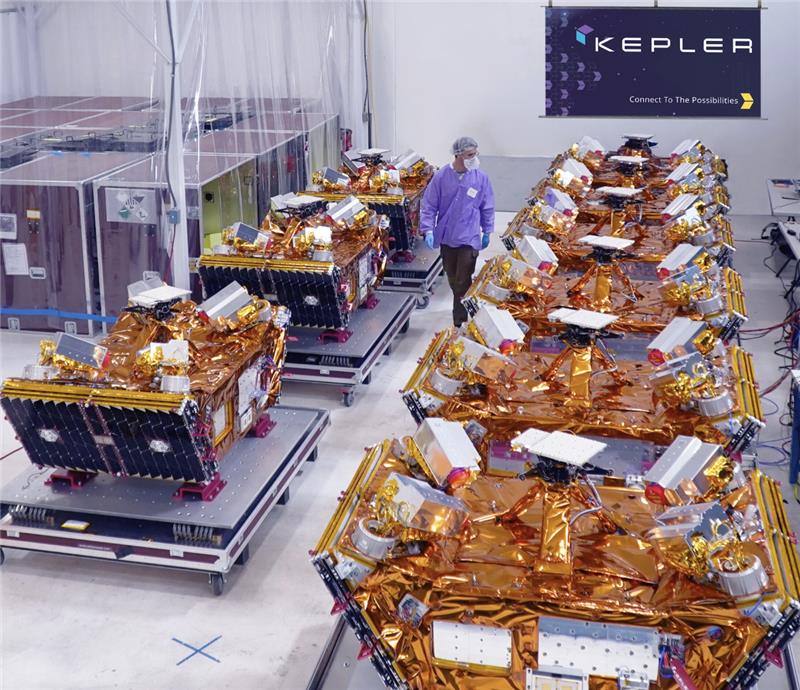

The largest compute cluster currently in orbit was launched by Canada’s Kepler Communications, featuring approximately 40 Nvidia Orin edge processors across 10 operational satellites. This cluster connects via laser communications links and marks a significant development in the landscape of orbital computing.
Kepler, now serving 18 customers, recently announced a partnership with startup Sophia Space. According to Kepler CEO Mina Mitry, the company aims to provide infrastructure for applications in space rather than operate as a traditional data center.
Experts project that large-scale data centers, similar to those envisioned by SpaceX or Blue Origin, are unlikely to materialize until the 2030s. In the near term, the focus will be on processing data in orbit to enhance space-based sensors used by both private companies and government agencies.



Sophia Space focuses on developing passively-cooled space computers to address the heating challenges associated with powerful processors in orbit. Under the new partnership, Sophia will upload its proprietary operating system to one of Kepler’s satellites, configuring it across six GPUs on two spacecraft.
This will be the first attempt to configure such software in orbit, a critical step for Sophia as it prepares for its first satellite launch expected in late 2027. Currently, Kepler processes data uploaded from the ground or collected by payloads on its own satellites.
As the sector matures, Kepler anticipates providing network services alongside third-party satellites. Mitry indicated that satellite companies are increasingly designing future assets to offload processing power, particularly for advanced sensors like synthetic aperture radar, with the U.S. military playing a key role in this demand.
Kepler has already demonstrated a space-to-air laser link for the U.S. government, reinforcing its capabilities in edge processing. This approach deals with data where it is collected, enabling faster responsiveness, setting the context for the value of orbital data centers.
While established companies like SpaceX and Blue Origin focus on large-scale data centers with high-capacity processors, Mitry emphasizes a preference for distributed GPUs designed for inference tasks over a single high-capacity GPU intended for training. “If this thing consumes kilowatts of power and you’re only running at 10% of the time, then that’s not super helpful,” Mitry stated. “In our case, our GPUs are running 100% of the time.”
Sophia CEO Rob DeMillo noted recent legislative actions that may limit data center construction on Earth. “Anything that limits data centers on Earth is making the space-based alternative more attractive,” DeMillo said, suggesting recent developments could reshape the future of data processing. “There’s no more data centers in this country,” he added, indicating a shift in the landscape of technology infrastructure.