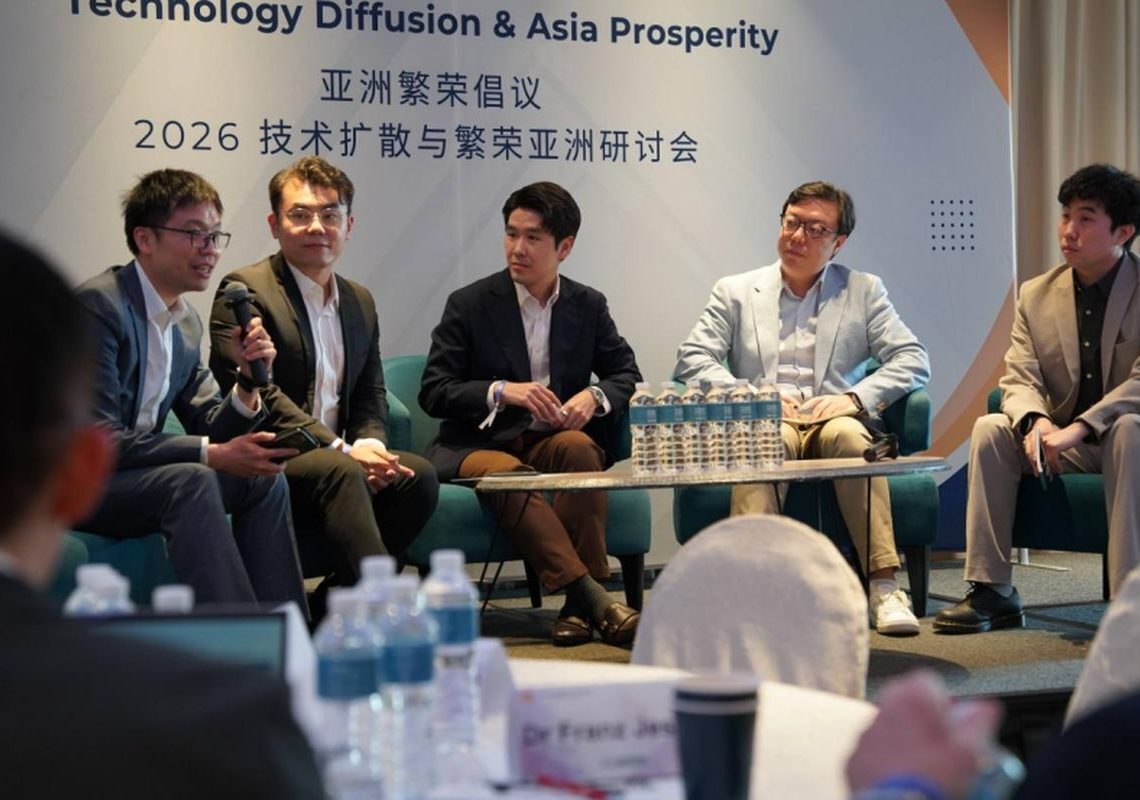

On February 27, Edge Research convened policymakers, academics and industry leaders in Singapore for the “Technology Diffusion and Asia Prosperity” seminar, marking the launch of its Asia Prosperity Initiative. As artificial intelligence continues to diffuse across sectors, discussions centered on how expanding deployment—particularly of AI agents—is reshaping applications, labor markets and governance frameworks.
AI agents move into broader deployment
As AI systems move beyond model development into practical use, the seminar highlighted the growing role of AI agents capable of operating across tasks and applications.
Alvin Chia noted that in financial services, AI agents are increasingly used in customer service automation, risk management assistance and trading decision support. While these applications improve efficiency, he cautioned that integrating additional tools into agents expands potential cybersecurity vulnerabilities. In highly regulated environments, unauthorized operations may create compliance and fraud risks.



Huang Jingyang discussed cross-application operations enabled by screen-reading permissions and simulated clicks. Although originally designed to assist visually impaired users, such mechanisms may introduce privacy and data misuse concerns when deployed commercially. Protocol-based approaches such as A2A and MCP were discussed as alternatives that may offer stronger privacy protection and ecosystem sustainability.
As deployment expands, accountability becomes more complex. Wang Yin emphasized that AI agents’ “black-box” decision-making complicates responsibility attribution among developers, deployers and users. Zhang Fan compared AI agents to “butlers,” suggesting that excessive delegation could expose individuals to privacy and security risks.
Employment shifts in the AI diffusion process
The discussion of accountability unfolded alongside broader examination of AI diffusion across industries.
Professor Lawrence Loh observed that corporations—including Google in the United States and Alibaba and Tencent in China—now lead much of frontier AI innovation. As innovation shifts from universities to companies, certain entry-level roles face displacement pressure, intensifying competition among graduates and prompting reassessment of talent cultivation models.
Zhang Fan cited research suggesting generative AI disproportionately affects junior positions compared to mid- and senior-level roles. Companies may therefore take on a more active role in workforce training, referencing Palantir’s recruitment of high school graduates as an example of alternative pathways beyond traditional academic routes.
Governance frameworks continue to develop
As diffusion and deployment accelerate, regulatory responses are also developing.
Benjamin Goh referenced the EU AI Act as an early and influential governance effort. Across Asia, regulatory models are evolving in parallel. India’s AI Impact Summit proposed measures related to data sharing and management, while Singapore’s IMDA released a Model AI Governance Framework for Agentic AI earlier this year.
Participants noted that while Southeast Asia may not dominate foundational large-model development, strengths in localization and application-layer innovation position the region for continued digital growth as AI diffusion progresses.