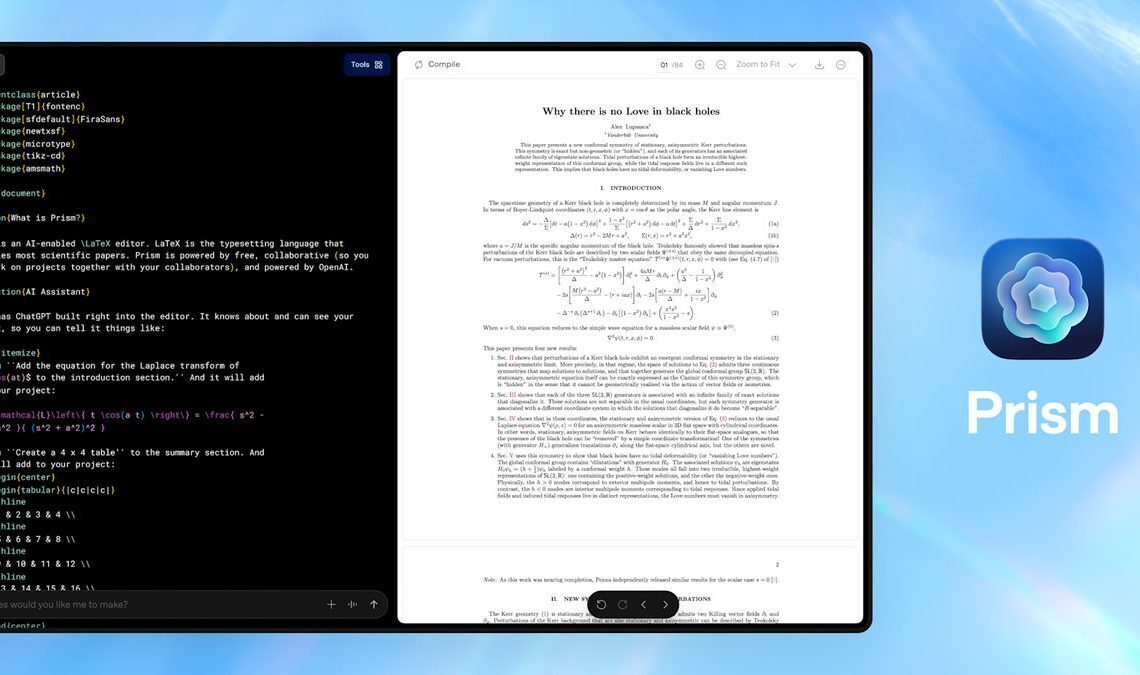

OpenAI launched Prism, a new AI-enhanced scientific workspace, on Tuesday. The tool is free for anyone with a ChatGPT account and accessible via a web app. Prism serves as a word processor and research assistant for scientific papers. It integrates deeply with GPT-5.2 to assess claims, revise prose, and search for prior research. The software requires human guidance and does not conduct research autonomously.
Executives described Prism as similar to coding interfaces such as Cursor and Windsurf, predicting it will speed up work for human scientists. In a press call, Kevin Weil, OpenAI’s VP of Science, said, “I think 2026 will be for AI and science what 2025 was for AI and software engineering.”
The launch coincides with rising scientific queries on OpenAI’s consumer products. ChatGPT receives an average of 8.4 million messages per week on advanced hard-science topics, though the share from professional researchers is unclear.



AI-assisted research is gaining traction among academics. In mathematics, AI models have proved several long-standing Erdos problems by combining literature review with novel applications of existing techniques. The proofs’ significance remains debated, but they mark an early success for AI and formal verification advocates.
A statistics paper published in December relied on GPT-5.2 Pro to produce new proofs for a central axiom of statistical theory. Human researchers handled only prompting and verification. OpenAI highlighted the paper in a blog post as an example of future human-AI collaboration in research. The post stated, “In domains with axiomatic theoretical foundations, frontier models can help explore proofs, test hypotheses, and identify connections that might otherwise take substantial human effort to uncover.”