

Enterprise digital transformation rarely fails due to technology limitations. Failure typically occurs when platforms scale faster than governance, integrations evolve without architectural oversight, and teams make delivery decisions without clear decision rights.
These challenges repeatedly surface in large Salesforce programs across enterprise and public-sector environments. As programs grow, architectural direction and governance models must evolve to manage the complexity that emerges after early delivery phases. Salesforce succeeds as a transformation platform only when architecture, integration strategy, and governance mature together.
Why architecture and governance define Salesforce success
Salesforce implementations rarely fail because the platform cannot scale. They struggle when architectural decisions lack governance or prioritize short-term delivery over long-term resilience. In large-scale programs, these patterns emerge when delivery velocity outpaces architectural oversight, reinforcing the need for architecture to mature alongside delivery.



In enterprise environments, Salesforce becomes the system where business urgency meets technical constraints. To meet delivery timelines, teams often rely on synchronous integrations, tightly coupled automations, and point-to-point data exchanges that introduce fragility at scale. Downstream outages can cascade into user-facing failures and slow releases.
Digital transformation reinforces this reality. Sustained digital value depends on how well architectural decisions align with governance structures rather than on technology adoption alone.
Long-term success depends on architectural decisions that anticipate growth, compliance, and change. Governance ensures those decisions remain consistent as teams, use cases, and integrations expand.
Architecting scalable Salesforce solutions
Scalability in Salesforce does not come from adding capacity. It comes from architectural intent. The most common scalability issues trace back to early design choices that did not account for peak transaction volume, integration ownership, or tightly coupled release dependencies. At scale, these choices often surface as synchronous dependencies in user transactions and integrations that do not isolate external failures.
Salesforce provides a clear set of integration patterns that help teams make these decisions intentionally. The integration patterns framework distinguishes between request-response, event-driven, batch, and streaming models based on latency tolerance, data ownership, and error-handling requirements. Applying these patterns early helps avoid brittle dependencies later.
A practical architecture step is to separate operations that must complete in the user transaction from those that can complete asynchronously with retries and monitoring.
For example, synchronous callouts often appear efficient during early rollouts. In one enterprise implementation, rising API response times under load caused cascading delays.
Architectural oversight later shifted the design to event-driven messaging. In this model, Salesforce publishes an event, and downstream processing occurs outside the user transaction.
Event-driven patterns reduce this risk by decoupling system availability from user interaction and aligning with the platform behaviors teams encounter when working within Salesforce’s developer documentation. This approach places error handling at the integration layer, using mechanisms such as replay and idempotent processing instead of UI-level compensating logic.
An enterprise system’s modularity links loosely coupled integration design with improved system resilience and faster adaptation to change. In Salesforce programs, this approach allowed scaling integrations without redesigning core business logic in each release cycle. This reduces the need for tightly coordinated releases across dependent systems.
Data integration and decision rights at scale
Integration strategy defines how Salesforce participates in the enterprise data landscape. Without clear ownership of shared entities and APIs, teams often duplicate logic across systems, introduce conflicting data models, and create integration sprawl that lacks governance and traceability.
This is most common when the system-of-record responsibility for shared data is not clearly established across platforms.
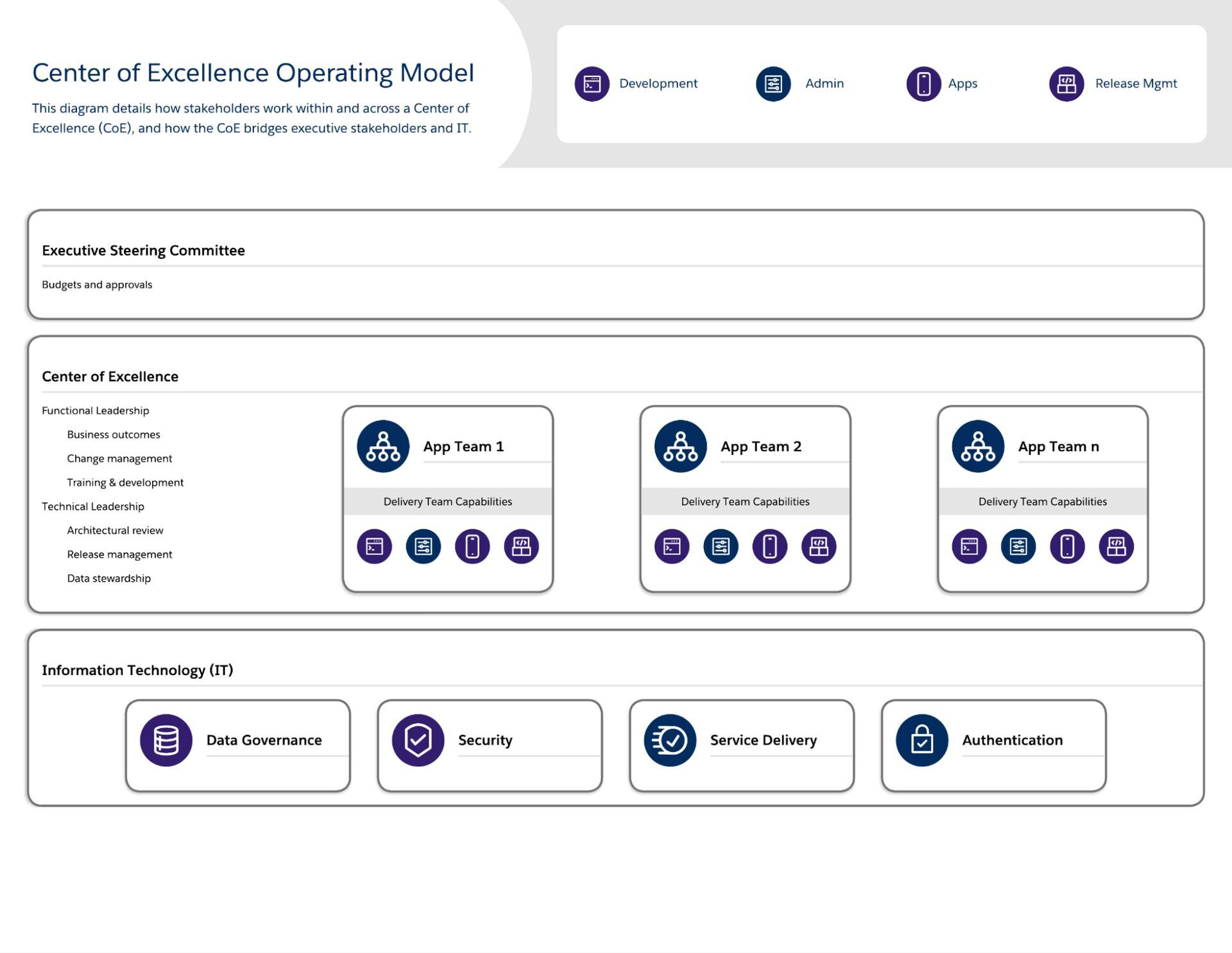
In large Salesforce programs, governance frameworks enforced under architectural leadership define integration approval, ownership of shared data entities and APIs, and formal escalation paths for architectural exceptions. These approvals typically cover integration pattern selection, API contract changes, shared data model updates, and security or boundary exceptions.
Integration decisions are often based on complexity, cost, and governance criteria. This framework helps teams decide not only how to integrate, but also who owns the integration lifecycle. Data-driven governance clarifies decision authority and lifecycle ownership. In regulated environments, architecture sets standards while delivery teams implement within those constraints through documented exceptions.
Delivery remains efficient when governance clarifies responsibility and lifecycle accountability across systems.
Governance through architecture review boards
Architecture review boards are often perceived as blockers, a view that usually reflects poor implementation rather than flawed intent. In practice, effective review boards accelerate delivery by reducing uncertainty and rework when they focus on a defined set of high-impact architectural decisions. Key areas are integration approach, data boundaries, security posture, and platform risk.
In mature Salesforce programs, review boards evaluate architectural patterns such as integration types, data access models, and security boundaries, rather than inspecting field-level or UI-specific changes.
To support this focus, reviews typically rely on lightweight inputs, including a system boundary diagram, the proposed pattern choice with a clear rationale, and identified risks or dependencies. This keeps reviews focused on architectural direction rather than implementation details.
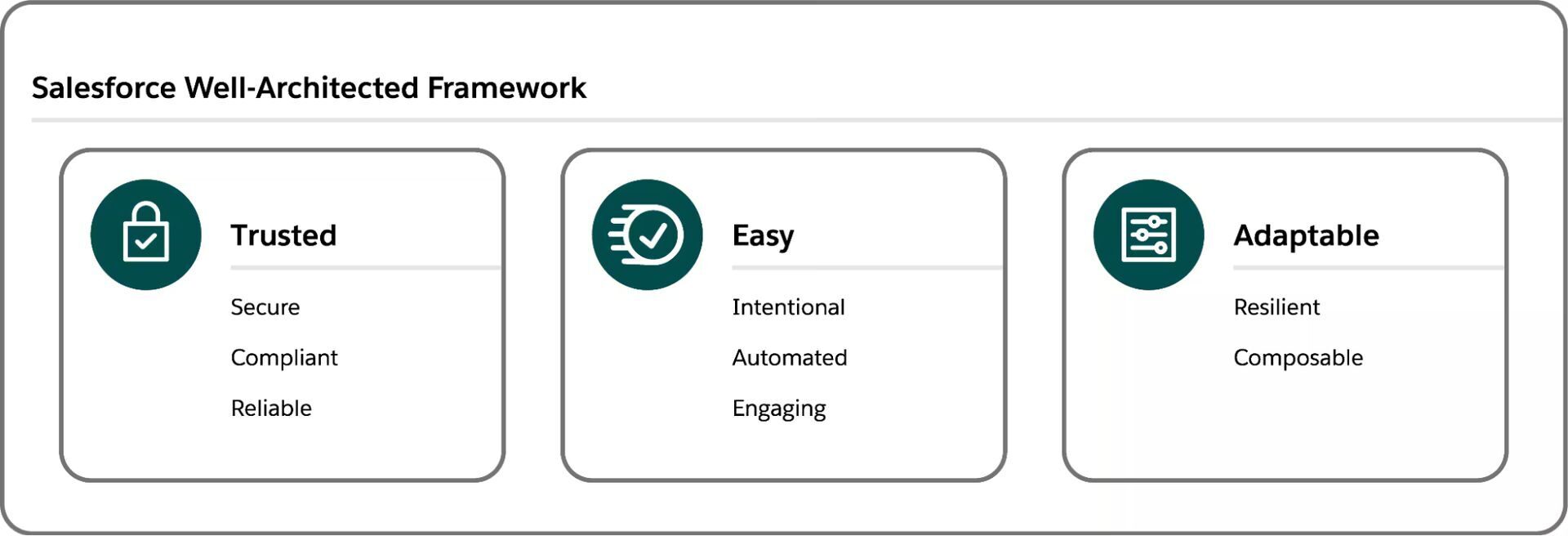
Salesforce’s well-architected framework provides a practical foundation for this model by framing architecture in terms of trust, usability, and adaptability as measurable outcomes rather than abstract ideas. Using a shared framework ensures review consistency by grounding decisions in security requirements, transaction design, and long-term adaptability.
When review boards operate with clear scope and cadence, teams gain autonomy within defined guardrails while reducing architectural drift and improving audit readiness.
Public sector transformation and service delivery
Public sector Salesforce programs introduce constraints that shape every architectural decision. Regulatory compliance, data privacy requirements, and cross-agency coordination limit the margin for error.
Digital transformation in governance emphasizes that technology improves public services only when data flows remain transparent, auditable, and coordinated across organizational boundaries. Salesforce supports these outcomes when architectures prioritize shared data models and governed integrations.
In health and benefits delivery programs such as WIC, Salesforce architectures designed for public sector use enable case visibility, eligibility workflows, and coordinated service delivery across agencies. These programs required architectural decisions like using asynchronous integrations for case intake and eligibility checks, enabling real-time access where needed while preserving audit trails for compliance and reporting.
These capabilities depend on clean integration between intake systems, eligibility engines, and reporting platforms. Well-governed Salesforce architectures improve transparency and reduce operational friction across agencies.
Building a CTO playbook for Salesforce governance
In enterprise Salesforce initiatives, CTO-level playbooks are developed and operationalized under solution architecture leadership to standardize decision-making, reduce delivery risk, and align technical execution with executive priorities. Their effectiveness depends on defining what must remain consistent across the platform while allowing flexibility within team-owned domains.
Repeatable governance frameworks improve delivery predictability and stakeholder trust, and large Salesforce implementations benefit from the same level of discipline applied to other enterprise platforms. A practical playbook focuses on a set of enforceable standards that guide delivery at scale, including:
- Architecture principles that shape design trade-offs and reduce ad hoc decision-making
- Integration pattern catalogs for common scenarios to reduce coupling and maintain system independence
- Data stewardship models that define ownership of shared entities across Salesforce and downstream platforms
- Release governance practices that align delivery velocity with platform stability through risk-informed checkpoints, along with lightweight decision records that capture pattern rationale and approved exceptions.
These standards evolve with the platform instead of remaining fixed. In large Salesforce programs, they often align with patterns and principles established through their architecture center. Updates are informed by recurring architecture review findings and changes in integration, security, or compliance requirements.
Governance remains effective only when teams share a consistent understanding of architectural standards.
In mature Salesforce delivery environments, that shared understanding tends to emerge through ongoing enablement, supported by practical reference materials rather than informal knowledge transfer alone. Common reference points such as Salesforce’s Trailhead platform reinforce expectations over time, while reference designs and short checklists help teams apply standards consistently during delivery.
Future outlook for AI-driven CRM
AI enhances CRM value only when data quality, integration maturity, and governance are already in place, and it cannot substitute for architectural discipline. Without architectural discipline, programs risk amplifying data inconsistency and automation bias.
Predictive models may train on duplicate data or misaligned attributes, leading to poor targeting and skewed eligibility decisions. Intelligent automation amplifies both the strengths and weaknesses of the underlying architecture. Future-ready CRM programs treat AI as part of the governance model, guided by strong integration foundations, data stewardship, and decision frameworks.
Long-term transformation depends on architecture and governance evolving alongside the integration strategy. Scalable design patterns, clear decision rights, and disciplined review structures allow organizations to accelerate delivery without sacrificing stability or compliance.
For technology leaders, the next step is to assess architectural maturity, integration resiliency, and governance readiness. Use structured tools such as architecture scorecards, pattern adoption audits, and escalation logs that surface risks before they affect delivery and compliance. These foundations support sustainable growth, reduce delivery risk, and establish Salesforce as a durable enterprise platform.
Featured image credit