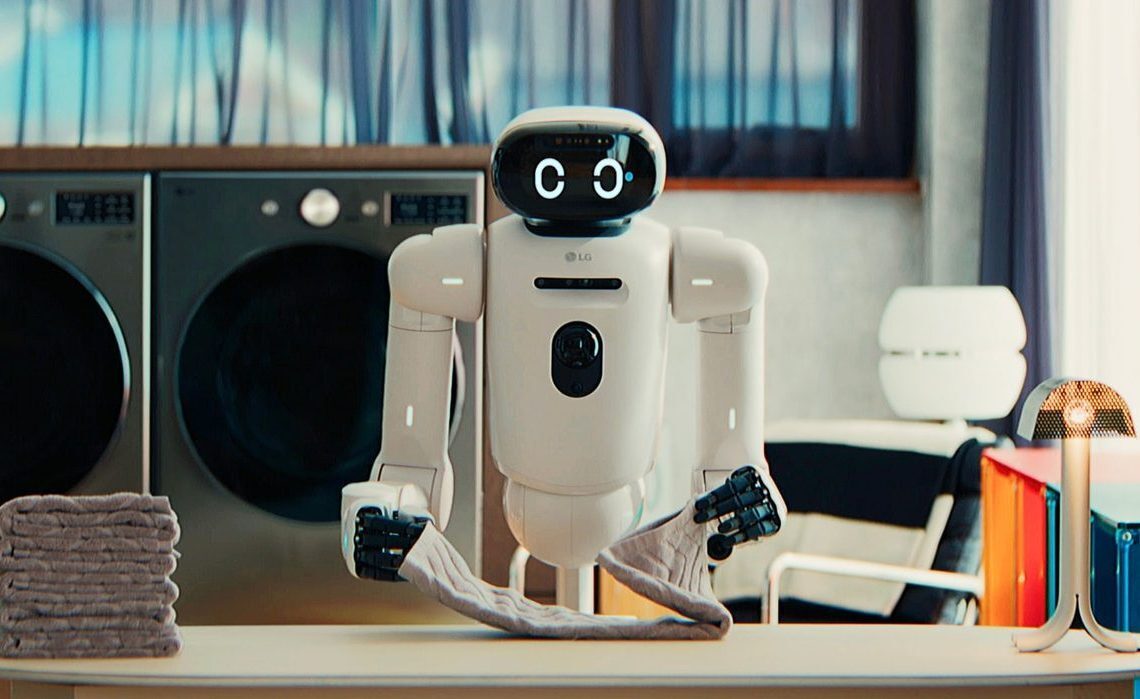

LG Electronics announced LG CLOiD, an AI-enabled home robot, on January 4, 2026. The company will demonstrate the robot publicly for the first time at CES 2026, held from January 6 to 9 in Las Vegas. LG CLOiD supports the company’s Zero Labor Home vision by performing and coordinating household tasks across connected appliances. This reduces time and physical effort for daily chores. The robot builds on LG’s Self-Driving AI Home Hub, known as LG Q9, and the ThinQ ecosystem.
At CES 2026, LG CLOiD will operate in simulated home environments. In one demonstration, the robot retrieves milk from a refrigerator and places a croissant into an oven to prepare breakfast. After occupants leave the home, LG CLOiD starts laundry cycles and folds and stacks garments once they dry. These actions show the robot’s capacity to understand user lifestyles and control appliances precisely.
The robot’s hardware includes a head unit, a torso with two articulated arms, and a wheeled base for autonomous navigation. The torso tilts to adjust height, allowing the robot to pick up objects from knee level and higher. Each arm features seven degrees of freedom, similar to a human arm. The shoulder, elbow, and wrist support forward, backward, rotational, and lateral movements. Each hand has five independently actuated fingers for precise manipulation. This design enables LG CLOiD to handle various household objects in kitchens, laundry rooms, and living areas.


The wheeled base incorporates autonomous driving technology from LG’s robot vacuums and LG Q9. Engineers chose this form factor for stability, safety, and cost-effectiveness. A low center of gravity minimizes tipping risks, even if a child or pet contacts the robot.
LG CLOiD’s head unit serves as a mobile AI home hub. It contains a chipset that acts as the robot’s brain, along with a display, speaker, cameras, sensors, and voice-based generative AI. These components enable communication with humans through spoken language and facial expressions. The head learns users’ living environments and lifestyle patterns. It also controls connected home appliances based on this data.
The robot employs Physical AI technology with two key models. The Vision Language Model (VLM) converts images and video into structured language-based understanding. The Vision Language Action (VLA) module translates visual and verbal inputs into physical actions. Training data consists of tens of thousands of hours of household task footage. This allows LG CLOiD to recognize appliances, interpret user intent, and perform actions like opening doors or transferring objects.
LG CLOiD integrates with LG’s smart home ecosystem. This includes the ThinQ AI Home Platform and the ThinQ ON hub. The connection expands the robot’s abilities to manage services across LG appliances.
LG introduced the LG Actuator AXIUM brand alongside the robot. These actuators function as robot joints, combining a motor for rotational force, a drive for electrical signal control, and a reducer for speed and torque regulation. Actuators represent a critical, high-cost component in robots and qualify as strategic technology for Physical AI. LG draws from its home appliance expertise to produce actuators with lightweight and compact designs, high efficiency, and high torque. Modular design supports customization and multi-variety production needed for advanced robots, which use dozens of actuator types.
LG outlined a development roadmap for home robotics and appliances. The company will advance home robots for housework functions and forms. It will apply robotics technology to create Appliance Robots, such as robot vacuums, and Robotized Appliances, like refrigerators with automatically opening doors as people approach. The plan aims for an AI Home where AI appliances and robots handle housework, freeing people for rest, enjoyment, and valuable activities.
Steve Baek, president of the LG Home Appliance Solution Company, stated: “The LG CLOiD home robot is designed to naturally engage with and understand the humans it serves, providing an optimized level of household help. We will continue our relentless efforts to achieve our Zero Labor Home vision, making housework a thing of the past so that customers can spend more time on the things that really matter.”
Visitors to CES 2026 can interact with LG CLOiD in real-life scenarios at LG’s booth number 15004 in the Las Vegas Convention Center.
The announcement positions LG CLOiD as a central element in LG’s push toward automated homes. The robot connects robotics with smart appliances through Physical AI. Demonstrations highlight practical applications in everyday settings. Hardware choices prioritize safe operation in family environments. AI models process visual data to execute complex tasks. Ecosystem integration broadens control over home devices. The AXIUM actuators provide foundational technology for future robots. LG’s roadmap extends capabilities to both standalone robots and enhanced appliances.
Key hardware specifications include the seven degrees of freedom per arm and five actuated fingers per hand. The tilting torso expands reach from low to high positions. Autonomous navigation on wheels ensures mobility without fixed paths. The head’s sensors and AI enable adaptive learning from user behaviors. VLM handles visual interpretation, while VLA drives action execution. Training on extensive household data supports reliability in varied scenarios.
Actuator details emphasize LG’s component strengths. Motors generate force, drives manage signals, and reducers control output. These elements achieve efficiency gains in compact forms. Modular approaches allow production of diverse joint types required in service robots.
CES booth experiences will cover multiple household automation examples. The event runs four days, providing ample opportunity for public viewing. LG’s presence at booth 15004 focuses on tangible robot interactions.