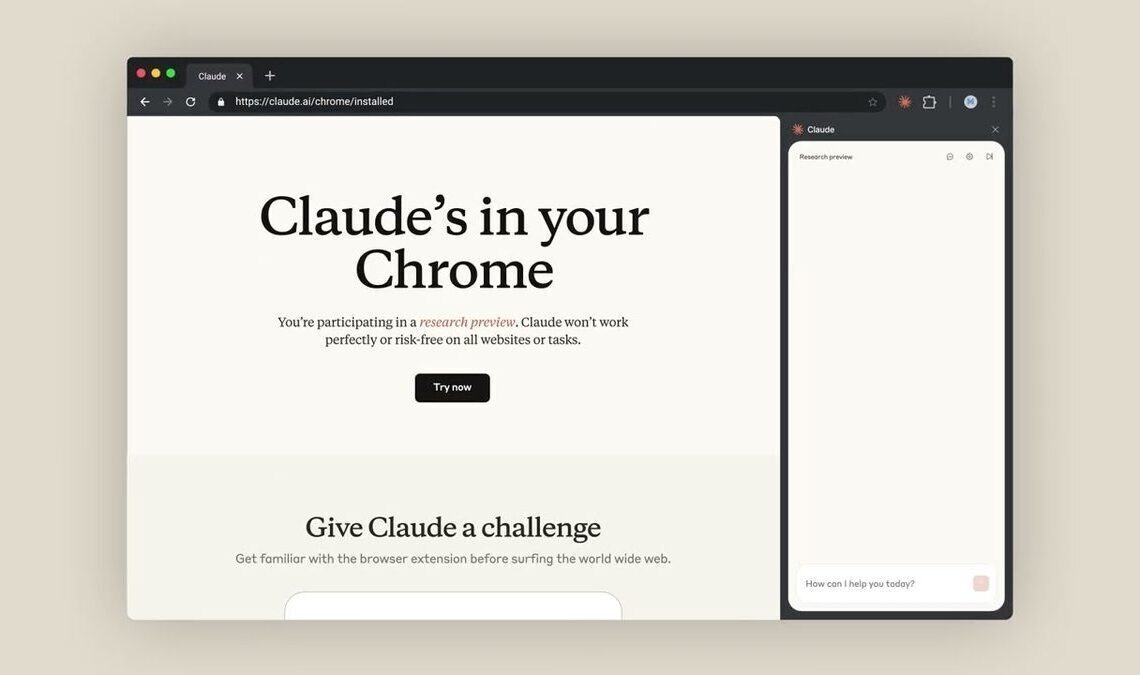

Anthropic has unveiled a research preview of Claude for Chrome, a browser-based AI agent powered by its Claude AI models. The announcement, made on Tuesday, signifies Anthropic’s move into the competitive landscape of AI-integrated browsers.
The initial rollout of Claude for Chrome is limited to 1,000 subscribers on Anthropic’s Max plan, which carries a monthly cost between $100 and $200. The company has also established a waitlist to accommodate other users expressing interest in accessing the AI agent.
By installing a dedicated Chrome extension, selected users gain the ability to interact with Claude via a sidecar window. This integration allows Claude to maintain awareness of the user’s browser activity and context. Furthermore, users have the option to grant Claude permission to execute actions within their browser, effectively delegating certain tasks to the AI agent.



The integration of AI into web browsers is emerging as a key area of competition among AI labs. Companies are seeking to create more seamless connections between AI systems and users through browser integrations. Perplexity recently launched Comet, its own browser featuring an AI agent designed to assist users with various tasks. OpenAI is also reportedly nearing the launch of its AI-powered browser, which is expected to offer similar functionalities to Comet. Google has also introduced Gemini integrations with Chrome.
The growing interest in AI-powered browsers is further fueled by Google’s ongoing antitrust case. A final decision in the case is anticipated soon, and the presiding federal judge has indicated the possibility of mandating Google to divest its Chrome browser. In response to this potential outcome, Perplexity submitted an unsolicited offer of $34.5 billion to acquire Chrome. OpenAI CEO Sam Altman has also expressed his company’s interest in potentially acquiring the browser.
Anthropic’s blog post on Tuesday addressed the potential safety risks associated with AI agents possessing browser access. Last week, Brave’s security team identified a vulnerability in Comet’s browser agent, indicating susceptibility to indirect prompt-injection attacks. These attacks involve malicious code embedded within websites that could manipulate the agent into executing unintended instructions upon processing the page.
Perplexity’s head of communications, Jesse Dwyer, stated that the vulnerability raised by Brave has been addressed. Anthropic emphasized its commitment to addressing security concerns through the research preview program. The company has already implemented defenses against prompt injection attacks, reporting a reduction in the success rate of such attacks from 23.6% to 11.2%.
Users have the ability to restrict Claude’s browser agent’s access to specific sites through the app’s settings. Anthropic has also implemented default restrictions, preventing Claude from accessing websites offering financial services, adult content, or pirated material. Additionally, Claude’s browser agent is designed to request user permission before undertaking “high-risk actions like publishing, purchasing, or sharing personal data.”
Anthropic’s exploration of AI models capable of controlling computer screens dates back to October 2024, with the launch of an AI agent that could control a PC. However, initial testing revealed limitations in terms of speed and reliability. Since then, the capabilities of agentic AI models have improved. Modern browser-using AI agents, like Comet and ChatGPT Agent, demonstrate greater reliability in performing simple tasks. However, many agentic systems continue to face challenges with more complex problems.