
In the past decade, stabilization technology has transformed remarkably, becoming an indispensable tool in content creation and visual storytelling. As platforms like YouTube, TikTok, and Instagram have grown to dominate the digital landscape, the demand for smooth, professional-quality footage has risen dramatically.
It was during this pivotal moment in the industry that Hohem emerged. Over the past decade, Hohem has redefined the boundaries of stabilization technology, emerging as a leader in empowering creators to capture life’s moments with precision and ease.
 Hohem gimbal evolution: A decade of progress
Stability has always been a fundamental element of professional-looking video. In the early days of self-media, achieving this was a cumbersome affair. Content creators often relied on static tripods to reduce shakiness, sacrificing mobility and dynamic movement in their shots. More ambitious creators used heavy, expensive equipment like mechanical stabilizers, which were challenging to operate without professional training. Thus, Hohem’s first stabilizer was created, addressing the key need for stability.



From the debut of the iSteady series to the sophisticated advancements in AI tracking, 360° infinite spin, and integrated lighting, Hohem has consistently led the charge in making stabilization smarter, more intuitive, and universally accessible.
Take the journey of innovation in stabilization tools as an example: from the foundational HG1 in 2014, which introduced essential handheld stability, to the cutting-edge iSteady V3 in 2024, featuring advanced AI tracking and a detachable remote kit, each step has empowered creators to capture cinematic moments with ease. Portable gimbals have grown smarter and more versatile, transforming from simple stabilizers to intelligent companions that cater to every creator’s needs, enabling polished and professional-quality storytelling for everyone.
The evolution of AI in gimbals: Smarter tracking, better storytelling
Hohem began in 2016 with the world’s first face-tracking smartphone gimbal. This advancement allowed gimbals to automatically follow Humans, simplifying the process of solo shooting for mobile content creators.
In 2021, The AI vision sensor will enable the gimbal to automatically detect and track subjects without the need for a third-party app. It can recognize faces, objects, or even specific gestures, allowing the gimbal to lock onto a target and follow it during movement. The Built-in AI sensor provides gesture-based control, meaning users can start or stop tracking. This hands-free feature provides greater convenience and enhances user experience, especially for solo creators or vloggers.
The progression continued in 2023 with the introduction of magnetic AI tracking, a feature that enabled dual-angle tracking from both front and rear perspectives. This innovation offered creators greater versatility, allowing for smooth transitions between different framing angles and providing more dynamic storytelling options.
By refining tracking accuracy and broadening the creative applications of gimbals, AI has become a cornerstone of modern stabilization technology, pushing the boundaries of what creators can achieve.
 A decade of progress and possibility
Over the past decade, stabilization technology has grown from a specialized tool for professionals into an essential resource for creators at all levels. Hohem has been at the forefront of making advanced stabilization tools accessible to everyone. By consistently pushing boundaries and delivering innovative solutions, Hohem has played a key role in shaping the modern era of visual storytelling.
From the introduction of compact, AI-powered gimbals to user-centric features like gesture controls and multi-mode shooting, Hohem has championed the democratization of high-quality video production. Their tools have empowered a global community of creators—allowing them to capture life’s moments, tell compelling stories, and share their visions with the world.
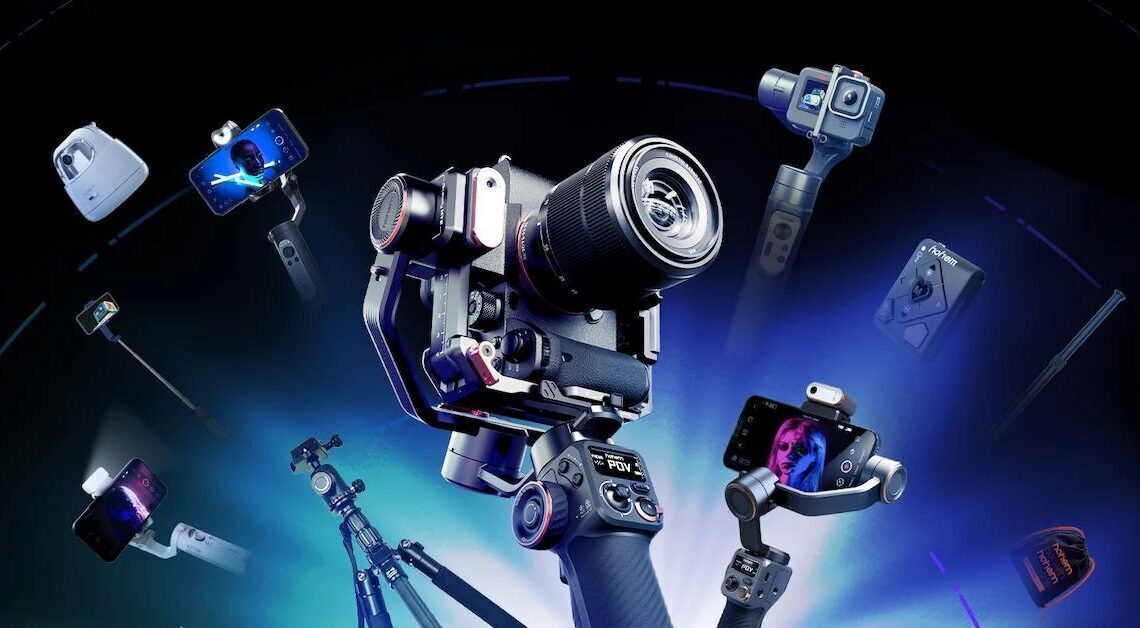
Featured image credit: Hohem