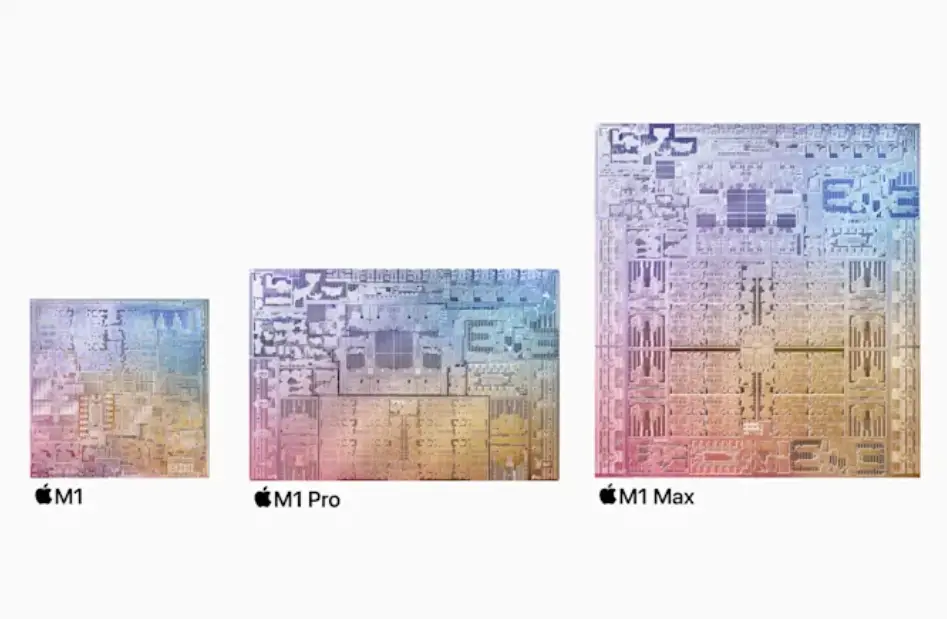

Here is the comparison between Apple M1 Max, M1 Pro, and M1 chips. Apple has now introduced us to two new, more powerful members of its M1 homegrown chip line, which it debuted in its latest MacBook Pro 14 and MacBook Pro 16 laptops at its fall Unleashed event Monday.
With the Apple M1 Pro and M1 Max, Apple continues to take another step toward abandoning Intel’s competing processors in its two-year mission to do so. Intel is introducing new 12th-gen Alder Lake chips, which include high-performance cores and low-power cores, a design borrowed from phone chips to better balance performance and battery life.
There’s no doubt that there’ll be some uncertainty. The three distinct lines of Apple’s processors, which are referred to as “cores,” break into many versions that may be customized with a system, owing to changes in the number of CPU and GPU cores that fall under the same model name.


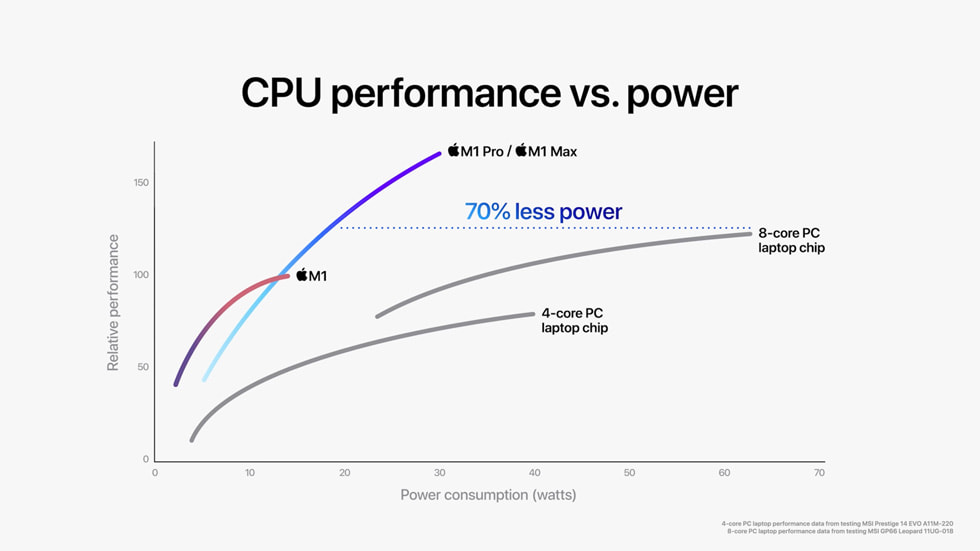
For instance, there are two versions of the M1 Pro, one with eight CPU cores and 14 GPU cores and one with 10 CPU cores and 16 GPU cores. But at least companies like Intel and AMD provide clear naming conventions for each, while Apple opts for a friendlier, but oversimplified approach that makes comparisons more difficult.
APPLE M1 VS. M1 PRO VS. M1 MAX
| Apple M1 | Apple M1 Pro | Apple M1 Max | |
|---|---|---|---|
| Total CPU cores | 8 | 8 or 10 | 10 |
| Performance cores | 4 | 6 or 8 | 8 |
| Efficiency cores | 4 | 2 | 2 |
| GPU cores | 7 or 8 | 14 or 16 | 24 or 32 |
| Neural engine cores | 16 | 16 | 16 |
| Maximum memory supported (UMA) | 16GB | 32GB | 64GB |
| Peak memory bandwidth (GBps) | n/a | 200 | 400 |
| ProRes accelerators | None | 1 | 2 |
| Available in | MacBook Air, iPad Pro (5th gen), iMac 24 (2021), Mac Mini | MacBook Pro 14, MacBook Pro 16 (2021) | MacBook Pro 14, MacBook Pro 16 (2021) |
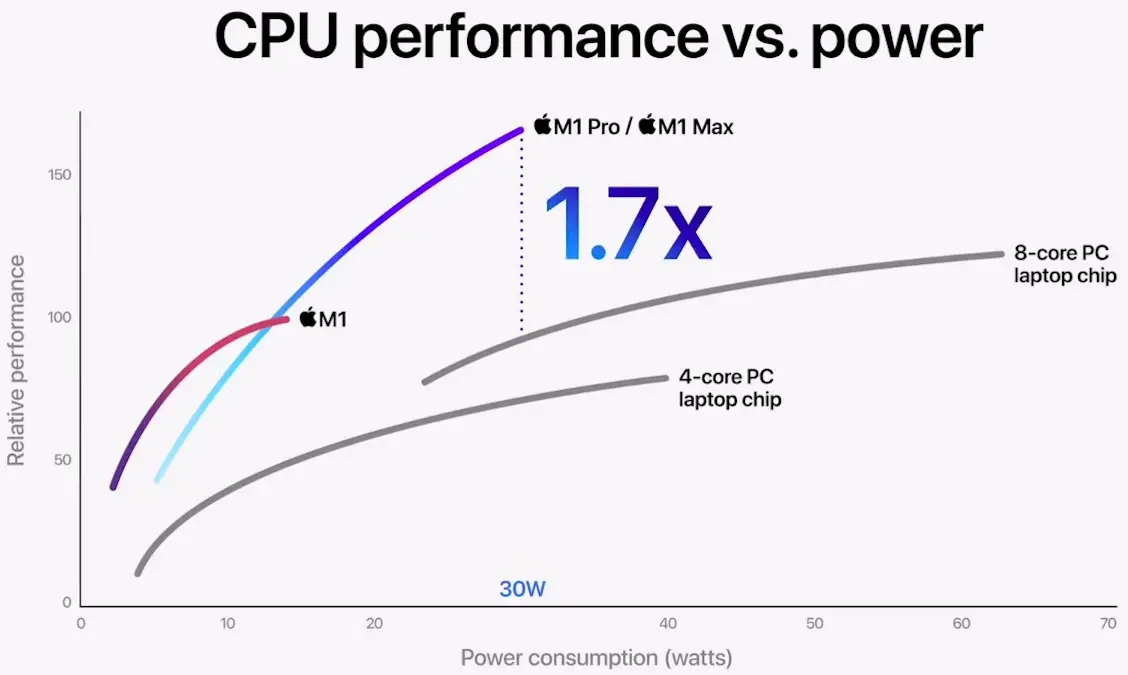
In terms of peak performance, the M1 Max and M1 Pro are clearly different, with the M1 Max doubling some key contributors to theoretical performance, notably the number of hardware ProRes accelerator cards, which is especially important for professional video editing. Some internal connections, such as that between memory and processor, have been increased by a factor of two. Those will not always be achieved in actual-world situations.
All of the M1 implementations to date have no mention of discrete graphics support. The M1 Max integrates Apple’s first mobile GPU with an integrated Apple-designed GPU, the A-series. The company touts that this device can support up to 64GB of RAM for the most memory accessible on a mobile GPU.
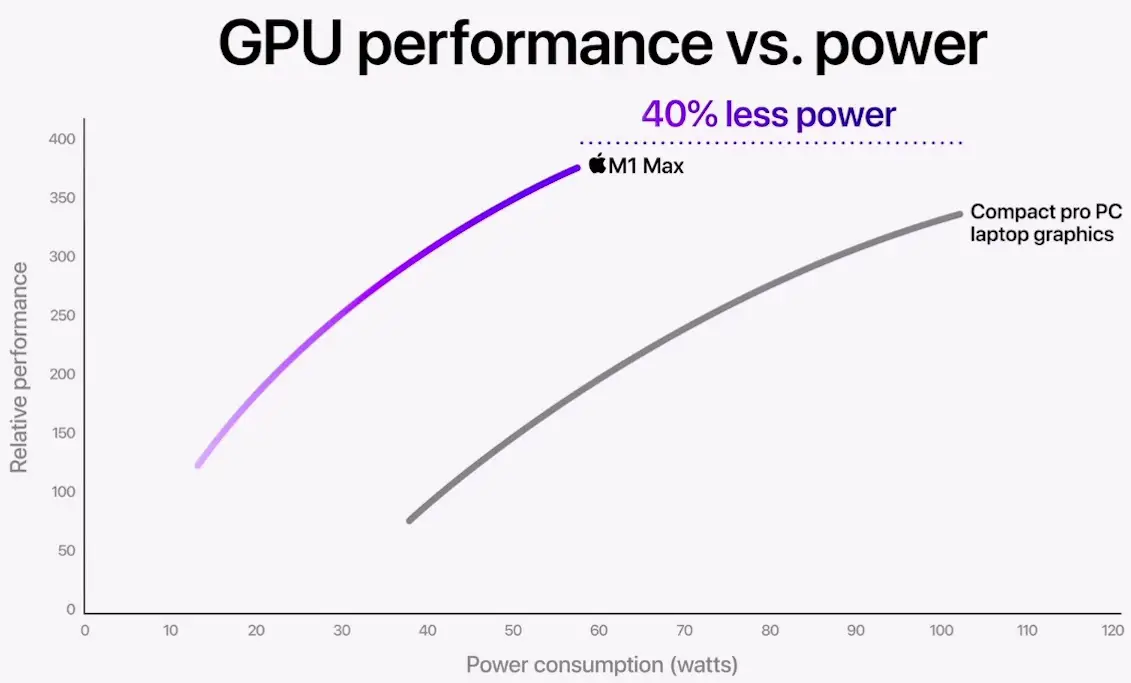
Keep in mind that because Apple’s unified memory architecture distributes memory across the GPU and CPU, it’s superior for performance since it allows data to be transferred more rapidly between both of them. In comparison, Intel’s UMA restricts the amount of memory available to an integrated GPU, and discrete GPUs utilize a PCIe-based Resizable BAR that allows the CPU but not the video memory.
However, you may run into issues if your apps need both the CPU and GPU, such as demanding 3D simulations.