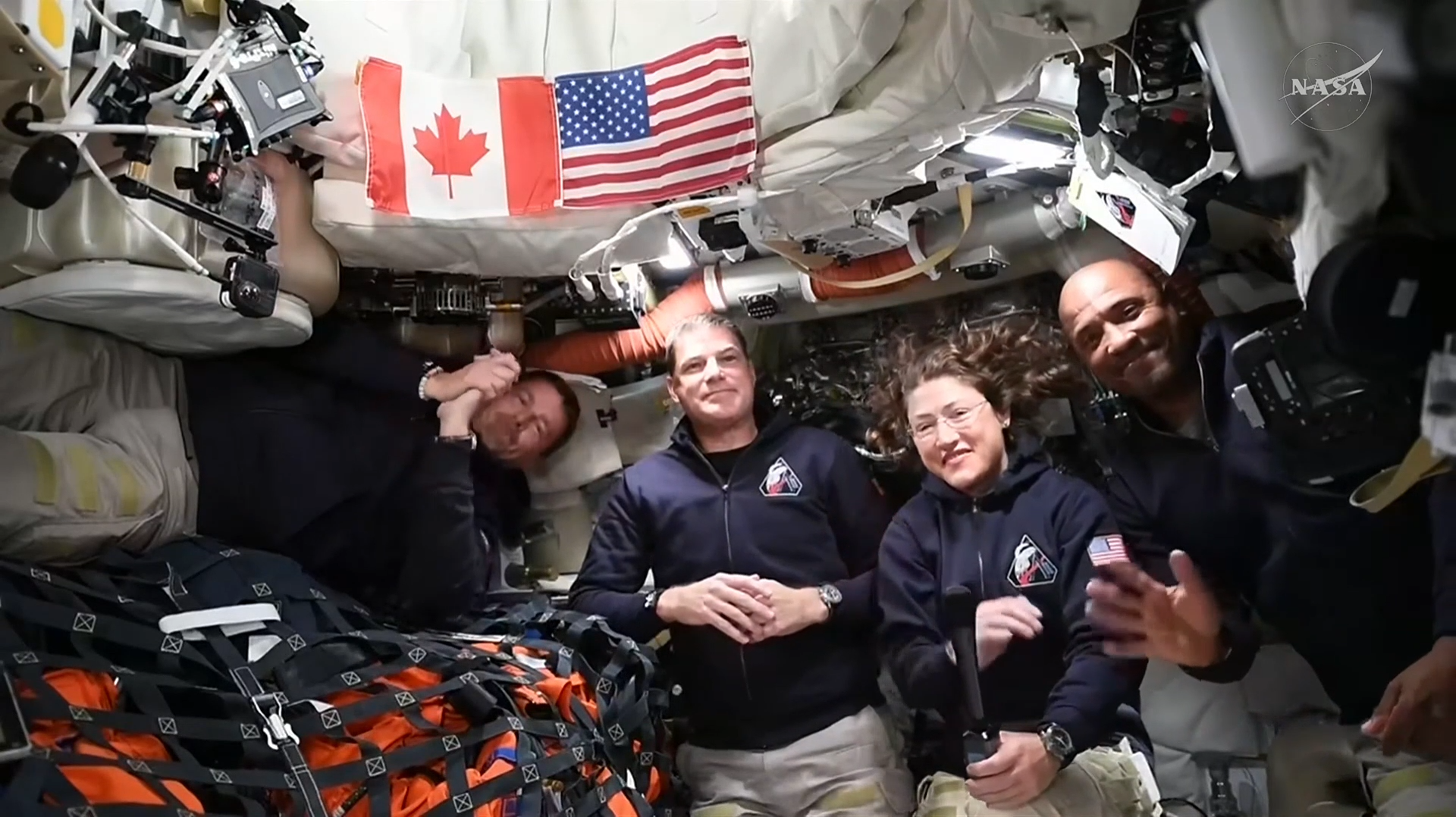

Artemis II and its four-person crew have entered the Moon’s “sphere of influence,” marking a significant milestone in the mission as the spacecraft is now more influenced by lunar gravity than by Earth’s. This transition occurred at a distance of 39,000 miles from the Moon, four days, six hours, and two minutes into the mission.
The mission will take astronauts Reid Wiseman, Christina Koch, Victor Glover, and Canada’s Jeremy Hansen farther into space than any human has traveled before. At their apogee, they are expected to reach a distance of 252,757 miles from Earth, breaking the Apollo 13 record by over 4,000 miles. This event signifies the first time humans have crossed the lunar boundary since the Apollo 17 mission in 1972.
The crew conducted manual piloting demonstrations and reviewed science objectives over the weekend, preparing for the upcoming flyby. They evaluated their life support space suits and shared moments enjoying views of Earth from the Orion spacecraft’s windows. NASA has released images of the astronauts as they look back at Earth.



Orion is anticipated to reach the Moon’s vicinity shortly after midnight on April 6. Later that day, the crew is expected to surpass the previous distance record of 248,655 miles, set by Apollo 13 in 1970. The lunar observation period will commence at 2:45 PM ET on April 6.
Communication with the crew will be temporarily lost a few hours later when they cross behind the Moon. The spacecraft’s closest approach to the Moon is scheduled for 7:02 PM ET, when it will be at a distance of 4,066 miles from the lunar surface. NASA stated, “From that distance, the crew will see the entire disk of the Moon at once, including regions near the north and south poles.”
The crew will also witness a solar eclipse during the mission, as Orion, the Moon, and the Sun will align, leading to the Sun disappearing behind the Moon for approximately one hour. NASA will begin live coverage of the flyby at 1 PM ET on April 6.