
TechBriefly
  • Tech
  • Business
  • Crypto
  • Science
  • Geek
  • How to
  • About
    • About TechBriefly
    • Terms and Conditions
    • Privacy Policy
    • Contact Us
    • Languages
      • 中文 (Chinese)
      • Dansk
      • Deutsch
      • Español
      • English
      • Français
      • Nederlands
      • Italiano
      • 日本语 (Japanese)
      • 한국인 (Korean)
      • Norsk
      • Polski
      • Português
      • Pусский (Russian)
      • Suomalainen
      • Svenska
No Result
View All Result
TechBriefly
Home news
How Google plans to secure its ecosystems in 2025

How Google plans to secure its ecosystems in 2025

In 2024, Google Play Protect scanned over 200 billion apps every day, up from 125 billion in 2023

Kerem GülenbyKerem Gülen
30 January 2025
in news, Security
Reading Time: 2 mins read
Share on FacebookShare on Twitter

Google has updated its Play Protect functionality, implementing new safety measures, including disabling app scanning during phone and video calls to combat social engineering attacks.

Changes to Google Play Protect

In 2024, Google Play Protect scanned over 200 billion apps every day, up from 125 billion in 2023. Real-time scanning has identified over 13 million new malicious apps from outside Google Play this year.

The “Scan apps with Play Protect” toggle will remain enabled during phone calls, or voice and video calls in popular third-party apps. This change aims to prevent scammers from manipulating users into disabling Play Protect during calls to download malicious apps from the Internet. Google’s interface warns: “If you’re asked to turn off app scanning, it may be a scam to try installing harmful apps on your device.”
How Google plans to secure its ecosystems in 2025
Image: Google

Additionally, Chrome for Android will prompt users to re-enable Play Protect if it has been turned off.

More than 95 percent of installations from major malware families that exploit sensitive permissions highly correlated to financial fraud stem from Internet-sideloading sources like web browsers, messaging apps, or file managers, according to Google’s research.

Google has expanded its enhanced fraud protection pilot to countries including Brazil, Hong Kong, India, Kenya, Nigeria, Philippines, South Africa, Thailand, and Vietnam.

How Google plans to secure its ecosystems in 2025
Image: Google

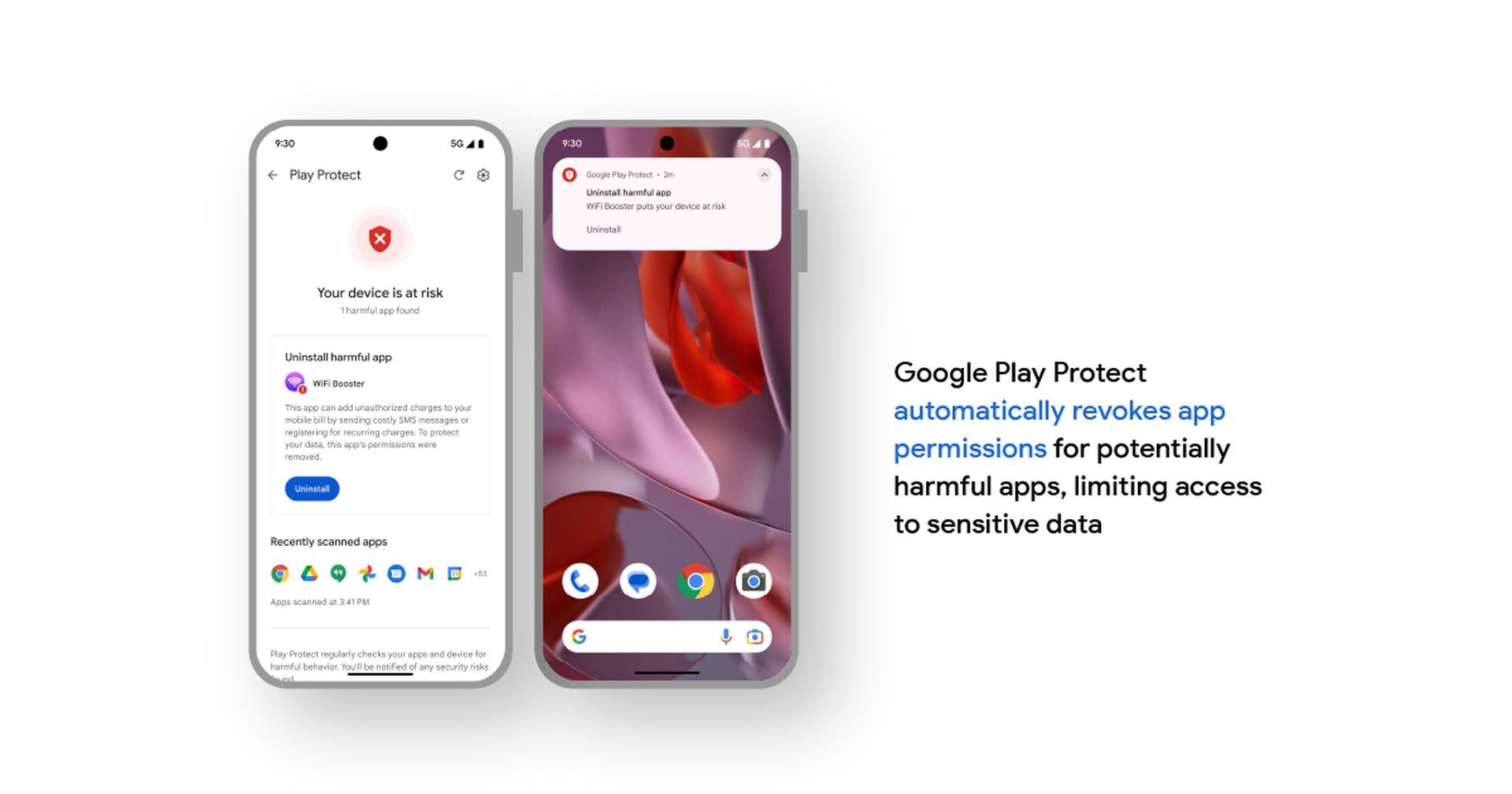
Google Play Protect will now automatically revoke permissions for potentially harmful apps, limiting their access to sensitive data like storage, photos, and camera. Users can restore app permissions at any time, though a confirmation step will be required for added security.

Additional 2024 safety statistics highlighted by Google include: preventing 2.36 million policy-violating apps from being published on Google Play, banning more than 158,000 developer accounts attempting to publish harmful apps, and blocking 1.3 million apps from gaining excessive access to sensitive user data. Moreover, over 91% of app installs on Google Play now utilize protections from Android 13 or newer.

How Google plans to secure its ecosystems in 2025
Image: Google

Apps employing Play integrity features report 80% lower usage from unverified and untrusted sources on average. Google Play Protect’s enhanced fraud protection pilots have shielded 10 million devices from over 36 million risky installation attempts across more than 200,000 unique apps.

Google stated its commitment: “We’re sharing how we kept Google Play safe from bad apps in 2024. In 2024, we continued to invest in more ways to protect our community and fight bad actors, so billions of people can trust the apps they download from Google Play and millions of developers can build thriving businesses.”

How Google plans to secure its ecosystems in 2025
Image: Google

Play Protect scans all apps, including sideloaded ones, and can block or disable harmful apps based on severity. If Google identifies a harmful app, it removes it from the Play Store and alerts users if they have it installed on their device.

To further enhance security, Play Protect will also check that apps originated from the Play Store and verify they have not been tampered with. App developers can begin restricting full app functionality to devices running Android 13 or newer starting next month.


Featured image credit: Pawel Czerwinski/Unsplash

Tags: featuredGoogle
ShareTweet
Kerem Gülen

Kerem Gülen

Kerem from Turkey has an insatiable curiosity for the latest advancements in tech gadgets and a knack for innovative thinking. With 3 years of experience in editorship and a childhood dream of becoming a journalist, Kerem has always been curious about the latest tech gadgets and is constantly seeking new ways to create. As a Master's student in Strategic Communications, Kerem is eager to learn more about the ever-evolving world of technology. His primary focuses are artificial intelligence and digital inclusion, and he delves into the most current and accurate information on these topics.

Related Posts

Anna’s Archive leaks 300TB of Spotify’s music catalog

Anna’s Archive leaks 300TB of Spotify’s music catalog

22 December 2025
EU regulators accuse TikTok of ongoing data transfers to China

EU regulators accuse TikTok of ongoing data transfers to China

22 December 2025
Cisco announces hackers exploiting AsyncOS zero-day

Cisco announces hackers exploiting AsyncOS zero-day

19 December 2025
Koi uncovers data harvesting in Urban VPN Proxy

Koi uncovers data harvesting in Urban VPN Proxy

19 December 2025

LATEST

How to connect a PS4 controller to Steam via USB or Bluetooth

How to connect your phone to Wi-Fi and fix connection issues

Apple begins iPhone 18 series production testing in January

EA investigates AI claims in Battlefield 6 cosmetics

Amazon Alexa+ will book your hotels and salons starting in 2026

OpenAI launches Skills in Codex

The comprehensive guide to resolving Steam account sign-in errors

Simple ways to pair and set up smartwatches with Android devices

How to zoom out quickly with shortcuts and gestures on your Mac

Viewing browsing history across Safari, Chrome and Firefox on Mac

TechBriefly

© 2021 TechBriefly is a Linkmedya brand.

  • Tech
  • Business
  • Science
  • Geek
  • How to
  • About
  • Privacy
  • Terms
  • Contact
  • | Network Sites |
  • Digital Report
  • LeaderGamer

Follow Us

No Result
View All Result
  • Tech
  • Business
  • Crypto
  • Science
  • Geek
  • How to
  • About
    • About TechBriefly
    • Terms and Conditions
    • Privacy Policy
    • Contact Us
    • Languages
      • 中文 (Chinese)
      • Dansk
      • Deutsch
      • Español
      • English
      • Français
      • Nederlands
      • Italiano
      • 日本语 (Japanese)
      • 한국인 (Korean)
      • Norsk
      • Polski
      • Português
      • Pусский (Russian)
      • Suomalainen
      • Svenska