

TechBriefly
  • Tech
  • Business
  • Crypto
  • Science
  • Geek
  • How to
  • About
    • About TechBriefly
    • Terms and Conditions
    • Privacy Policy
    • Contact Us
    • Languages
      • 中文 (Chinese)
      • Dansk
      • Deutsch
      • Español
      • English
      • Français
      • Nederlands
      • Italiano
      • 日本语 (Japanese)
      • 한국인 (Korean)
      • Norsk
      • Polski
      • Português
      • Pусский (Russian)
      • Suomalainen
      • Svenska
No Result
View All Result
TechBriefly
Home Science Physics
247 zeptoseconds: the shortest unit of time ever recorded

247 zeptoseconds: the shortest unit of time ever recorded

Kerem GülenbyKerem Gülen
19 October 2020
in Physics, Science
Reading Time: 2 mins read
Share on FacebookShare on Twitter

The scientists have managed to measure the shortest unit of time ever recorded: 247 zeptoseconds for a photon to cross the hydrogen molecule. A new record has been broken. A group of researchers has managed to measure the shortest unit of time ever recorded: 247 zeptoseconds, which equals 0,000,000,000,000,000,247 seconds.

  • Scientists have confirmed the effects of 5G on health, but don’t worry
  • YouTube will delete misinforming COVID-19 vaccine videos
  • Elon Musk will present expected Neuralink chip this Friday

The record has managed to beat the previous one which was registered at 850 zeptoseconds. This record was registered in 2016 and since then researchers have been working on improving measurement instruments to achieve greater accuracy. In other words, the measurement tools are about three times more accurate now.

It takes 247 zeptoseconds for a photon to cross the hydrogen molecule

Such exaggeratedly small measurements are not used in real life, but they are useful in the field of chemistry and physics. Here in fact what is most used to measure the time it takes for molecules to form and break down is the femtosecond, which is two units above zeptoseconds. But if we want to measure how long it takes light to travel through a molecule, we have to go to the smallest unit that we can register at the moment: 247 zeptoseconds.

In a particle accelerator in Hamburg, a group of researchers has managed to measure this extremely short period of time. For this purpose, researchers from Goethe University irradiated hydrogen (H2) molecule with X-rays. The idea was to shoot a photon onto the molecule to expel its two atoms and measure the reaction. And it worked.
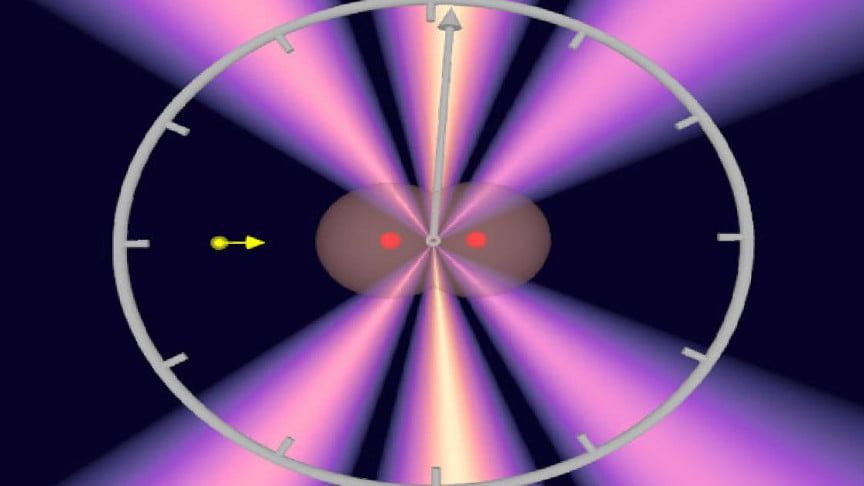
It takes 247 seconds for a photon to cross the hydrogen molecule

When the photon reached the first atom, it generated a wave and later the same thing happened with the second atom. The researchers were able to measure when the two waves collided to cancel each other out. With this and knowing the spatial position that the molecule had in relation to the light, they could determine the time that took the photon to cross the molecule: 247 zeptoseconds. Approximately, because it always depends on how separated are the two atoms in the molecule and the perspective of the light when it arrives.

Simplifying it a lot, the researchers were able to calculate how long it takes light to cross a hydrogen molecule. Being one of the simplest molecules, it is also one of the smallest, thus one of the shortest distances with a beginning and an end that light can travel. Light is the fastest thing in the Universe.

Perhaps in the future, we will be able to measure the time it takes to cross a single atom or even quarks (and beyond) of a proton. In that case, we will probably have to resort to the yoctosecond already.  For now it takes 247 seconds for a photon to cross the hydrogen molecule.

Tags: featuredsciencetime
ShareTweet
Kerem Gülen

Kerem Gülen

Kerem from Turkey has an insatiable curiosity for the latest advancements in tech gadgets and a knack for innovative thinking.With 3 years of experience in editorship and a childhood dream of becoming a journalist, Kerem has always been curious about the latest tech gadgets and is constantly seeking new ways to create.As a Master's student in Strategic Communications, Kerem is eager to learn more about the ever-evolving world of technology. His primary focuses are artificial intelligence and digital inclusion, and he delves into the most current and accurate information on these topics.

Related Posts

NASA’s James Webb Space Telescope discovers PSR J2322-2650b

NASA’s James Webb Space Telescope discovers PSR J2322-2650b

19 December 2025
NASA confirms 3I/ATLAS is an interstellar visitor behaving unlike anything in our system

NASA confirms 3I/ATLAS is an interstellar visitor behaving unlike anything in our system

30 October 2025
SpaceX launches 84 Starlink satellites in five days

SpaceX launches 84 Starlink satellites in five days

27 October 2025
AI reasoning models’ carbon footprint varies greatly

AI reasoning models’ carbon footprint varies greatly

2 July 2025
Please login to join discussion

LATEST

How to choose the right reset method for Samsung Galaxy devices

What resetting end-to-end encryption does on iPhone, iPad or Mac

How to easily monitor your AT&T data usage and avoid overages

How to reset your Bosch dishwasher when buttons won’t respond

Disney+ brings TikTok-style scrolling to its streaming app

Xbox reveals lineup for next Developer Direct: Fable, Forza and more

FIFA and TikTok partner to stream live World Cup clips

YouTube updates search filters to separate Shorts from long videos

Google introduces AI Inbox to organize Gmail tasks and updates

Announcements made by Samsung Display at CES 2026

TechBriefly

© 2021 TechBriefly is a Linkmedya brand.

  • Tech
  • Business
  • Science
  • Geek
  • How to
  • About
  • Privacy
  • Terms
  • Contact
  • | Network Sites |
  • Digital Report
  • LeaderGamer

Follow Us

No Result
View All Result
  • Tech
  • Business
  • Crypto
  • Science
  • Geek
  • How to
  • About
    • About TechBriefly
    • Terms and Conditions
    • Privacy Policy
    • Contact Us
    • Languages
      • 中文 (Chinese)
      • Dansk
      • Deutsch
      • Español
      • English
      • Français
      • Nederlands
      • Italiano
      • 日本语 (Japanese)
      • 한국인 (Korean)
      • Norsk
      • Polski
      • Português
      • Pусский (Russian)
      • Suomalainen
      • Svenska