Blue Origin targets late February for the third launch of its New Glenn mega-rocket, carrying an AST SpaceMobile satellite to low-Earth orbit. This marks the second commercial payload for New Glenn.
The company did not provide an immediate explanation for launching the AST SpaceMobile satellite instead of its robotic lunar lander, Blue Moon Mark 1 (MK1). The MK1 lander is currently undergoing vacuum chamber testing at NASA’s Johnson Space Center in Texas, with no set launch date.
This launch represents the third New Glenn mission in just over a year, following a decade of development.
February is anticipated to be an active month for spaceflight. NASA may launch its Artemis II mission, orbiting the moon with four astronauts, as early as February 6. SpaceX is expected to begin testing the third version of its Starship rocket. Additionally, NASA and SpaceX will conduct the Crew-12 mission to return the International Space Station to full staffing after the Crew-11 team’s medical evacuation earlier this month.
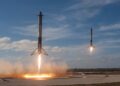
For the upcoming launch, Blue Origin will reuse the booster stage from New Glenn’s second mission, which occurred last November. The company recovered that booster by landing it on a drone ship at sea, a method similar to SpaceX’s Falcon 9 booster recoveries.
New Glenn serves as Blue Origin’s primary vehicle for delivering payloads to Earth orbit and beyond. It builds upon the suborbital New Shepard rocket program, operational for over ten years. Blue Origin has an agreement with AST SpaceMobile to deploy multiple satellites for the latter’s space-based cellular broadband network.
New Glenn is part of Blue Origin’s broader objectives. In November, the company unveiled a super-heavy New Glenn variant, which will be taller than a Saturn V rocket, comparable to SpaceX’s Starship. On Wednesday, the company announced TeraWave, a satellite internet constellation planned for deployment starting in late 2027.
Blue Origin also intends to utilize its Blue Moon landers for lunar and Martian missions. Concurrently, it is developing Blue Ring, a spacecraft designed to host and deploy payloads for other space companies.