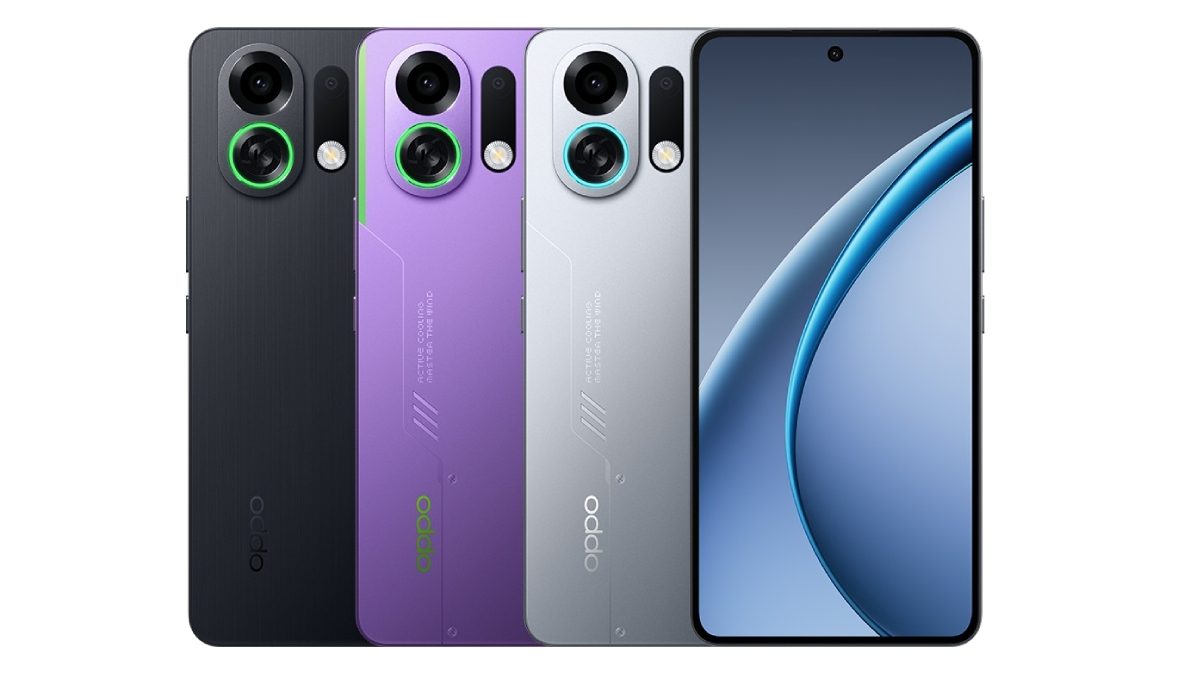

Oppo has officially launched the K13 Turbo and K13 Turbo Pro smartphones, introducing a novel active cooling system to the mobile market. Unlike most smartphones that rely on passive cooling, these new models integrate a micro centrifugal fan to manage heat, particularly during intensive tasks like gaming. This design choice aims to maintain optimal performance for their respective chipsets.
The Oppo K13 Turbo is powered by the Dimensity 8450, a 4nm TSMC chip featuring eight Cortex-A725 cores and a Mali-G720 MC7 GPU. In contrast, the Oppo K13 Turbo Pro utilizes the Snapdragon 8s Gen 4, also a 4nm TSMC chip, equipped with one Cortex-X4 and seven Cortex-A720 CPU cores, alongside an Adreno 825 GPU. Storage configurations differ between the two: the Pro model boasts faster UFS 4.0 storage, with options up to 512GB, while the standard Turbo uses UFS 3.1 storage, available up to 256GB. Both variants come with up to 16GB of LPDDR5X RAM.
A key innovation in both devices is the integrated micro centrifugal fan, which operates at speeds up to 18,000 RPM. This fan is designed with super slender 0.1mm blades and equally thin heat sink fins, contributing to a 20% improvement in heat dissipation. The cooling system is further enhanced by a 7,000mm² vapor chamber. A notable engineering feat is that despite the inclusion of an active fan, both the Oppo K13 Turbo and K13 Turbo Pro maintain comprehensive water resistance ratings: IPX6 for splashes, IPX8 for submersion, and IPX9 for water jets. The fan mechanism is also protected against drops.
Performance benchmarks under gaming scenarios highlight the effectiveness of the cooling system. After three hours of MOBA gaming in a 25°C room, the K13 Turbo (Dimensity 8450) sustained 119.9 frames per second (fps) with a temperature of 43.3°C. Under similar conditions, the K13 Turbo Pro recorded a temperature of 42.2°C, demonstrating the thermal efficiency across both chipsets.
Battery life is another strong suit, with both phones featuring large 7,000mAh batteries. Oppo emphasizes a “5 years of worry-free battery life” claim. Charging is facilitated by 80W SuperVOOC technology, capable of charging a depleted battery to 68% in just 30 minutes. Both models also support bypass charging, allowing the phone to be powered directly from a wall outlet, reducing battery wear during extended use.
The display on both devices is a 6.8-inch OLED panel, offering a resolution of 1,280 x 2,800 pixels and 10-bit color depth. They feature a 120Hz refresh rate and a 240Hz touch sampling rate, with a peak brightness of 1,600 nits. For an enhanced gaming experience, both phones incorporate frame generation, resolution upscaling, and Super HDR technologies, designed to improve visual quality without imposing additional strain on their respective GPUs.
In terms of camera capabilities, both phones feature a 50MP main sensor with a 27mm f/1.8 lens on the rear, supporting 4K @ 60fps video recording. A 2MP depth sensor accompanies the main camera. For selfies, a 16MP front-facing camera with a 23mm f/2.4 lens is included, capable of 1080p @ 30fps video recording. The Pro model benefits from Optical Image Stabilization (OIS) on its main camera, a feature absent on the standard Turbo.
Additional features common to both models include stereo speakers and X-axis linear motors for haptic feedback. They also integrate under-display fingerprint readers for secure authentication. Connectivity options vary slightly: the Turbo Pro supports Wi-Fi 7 (be), while the Turbo is equipped with Wi-Fi 6 (ax). Differences in 5G band support are also present, which could be a factor for potential global availability.
The Oppo K13 Turbo and K13 Turbo Pro are currently on pre-sale in China and will be officially available from July 25. Oppo has highlighted that these devices offer a strong performance-to-price ratio, particularly given their advanced engineering and features.