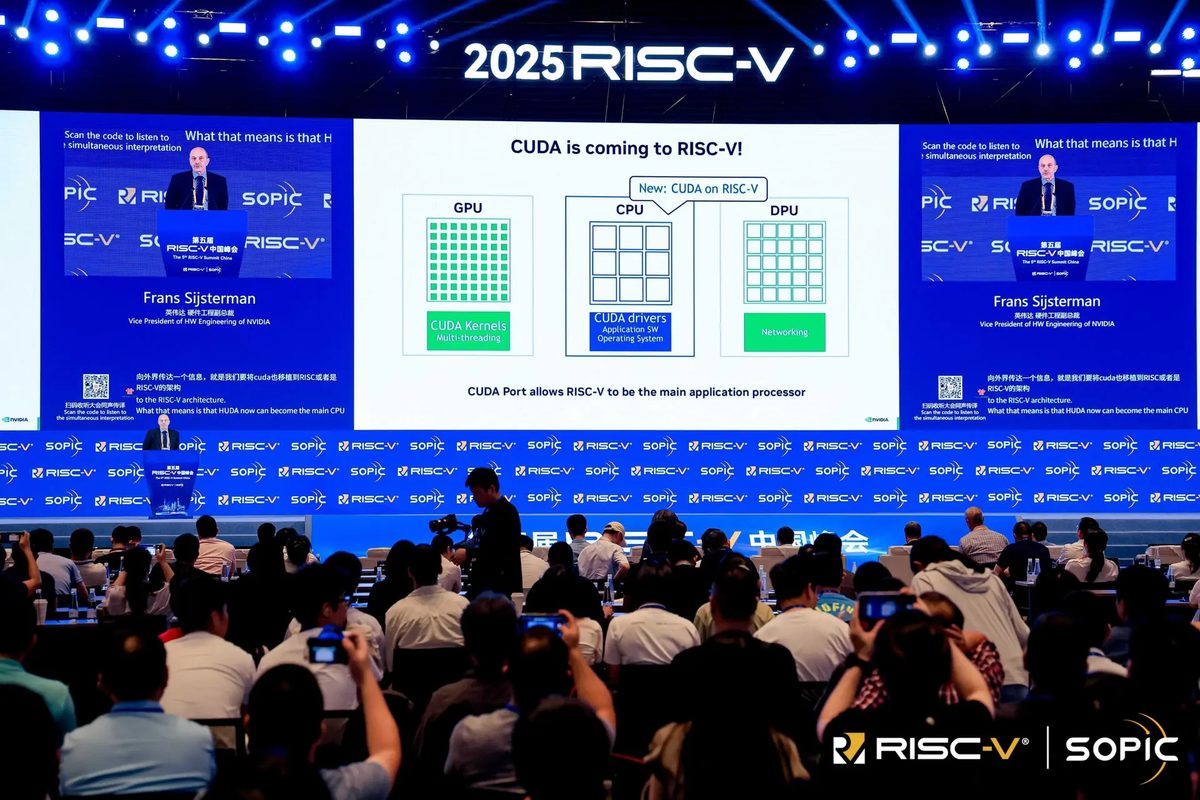

Nvidia has officially announced support for the RISC-V instruction set architecture (ISA) within its CUDA software platform, enabling RISC-V CPUs to serve as main processors for CUDA-based systems. This significant development, revealed at the 2025 RISC-V Summit in China, positions RISC-V alongside x86 and Arm as a compatible architecture for Nvidia’s AI and high-performance computing (HPC) ecosystems.
The announcement was delivered during a keynote by Frans Sijsterman, Vice President of Hardware Engineering at Nvidia, emphasizing the company’s growing engagement with the open-source ISA. Sijsterman’s presentation detailed how CUDA components will now operate on RISC-V, outlining a typical system configuration where a GPU handles parallel workloads while a RISC-V CPU manages CUDA system drivers, application logic, and the operating system. This setup allows the RISC-V CPU to orchestrate GPU computations seamlessly within the CUDA environment.
While the immediate application areas are expected to include CUDA-enabled edge devices, such as Nvidia’s Jetson modules, the integration also suggests Nvidia’s long-term vision for RISC-V in data centers. The presentation’s diagram further illustrated a comprehensive system that includes a Data Processing Unit (DPU) for networking tasks, creating a heterogeneous compute platform. In this configuration, the RISC-V CPU becomes central to managing workloads, complementing Nvidia’s GPUs, DPUs, and networking chips.
This move is seen as a strategic bridge between Nvidia’s proprietary CUDA stack and an increasingly prominent open architecture. For Nvidia, supporting RISC-V broadens CUDA’s reach into systems that prefer open instruction sets or require custom processor implementations, particularly relevant for companies seeking customized silicon solutions. The integration also strengthens options for developers utilizing Nvidia Jetson, targeting specialized or embedded computing platforms.
The timing of this announcement, made in China, is notable, especially given current geopolitical considerations affecting the export of advanced AI hardware like Nvidia’s GB200 and GB300 offerings to the region. By enabling CUDA on RISC-V, Nvidia appears to be finding new avenues to sustain and expand its CUDA ecosystem in markets that might favor an open instruction set or custom chip designs.
While Nvidia did not explicitly confirm that all workloads would be AI-related, the company’s current strategic focus strongly suggests this direction. The integration of RISC-V into the CUDA platform could influence other major tech companies to consider similar adaptations, potentially positioning RISC-V as a more viable alternative in future AI and HPC processor designs across data centers globally.