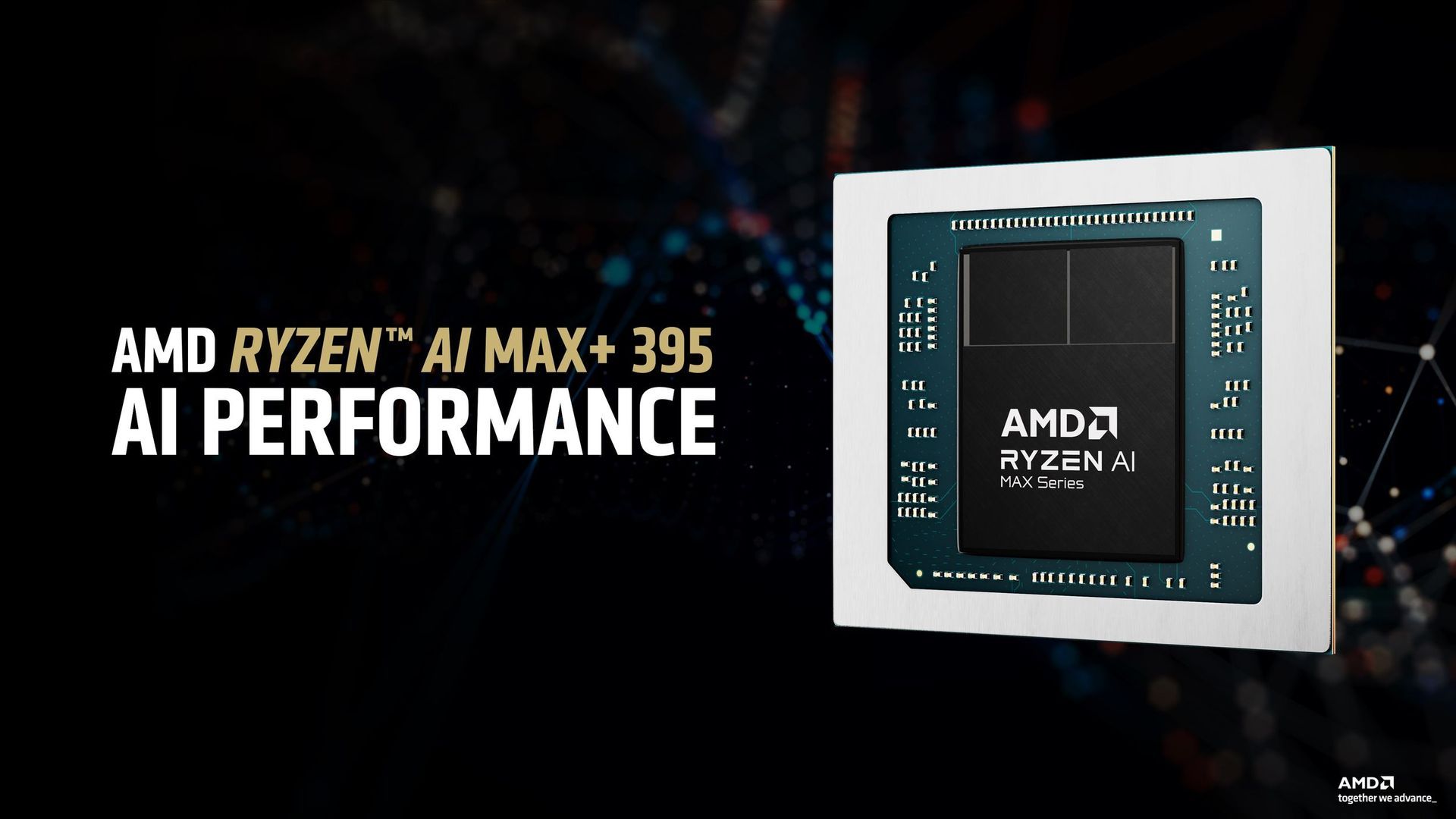

The AMD Ryzen AI Max+ 395 has been recognized as the “most powerful” x86 APU on the market for AI computing, with benchmarks supporting this claim. Official evaluations showcase its capabilities in handling AI workloads.
Specifications and performance metrics
The AMD Ryzen AI Max+ 395 features a 16-core processor with 32 threads, a peak AI TOPS of over 50 from its XDNA 2 NPU, and Radeon 8060S integrated graphics with 40 RDNA 3.5 Compute Units. It is primarily marketed by AMD for AI workload efficiency, particularly in applications such as LM Studio.
AMD’s benchmarks for the Ryzen AI Max+ 395 measure performance in ‘tokens per second’ and ‘time to first token’ using LM Studio. In testing, the “Strix Halo” processor in the Asus ROG Flow Z13, equipped with 64GB RAM, demonstrated notable advantages over a similar-spec Asus Zenbook S14, which has 32GB RAM and runs on the Intel Core Ultra 7 258V APU with integrated graphics clocked at 140V. Although this is not a direct 1:1 comparison due to differing memory capacities, the results illustrate the Ryzen AI Max+ 395’s significant performance in LM Studio 0.3.11 with various LLMs featuring a 16GB model size.
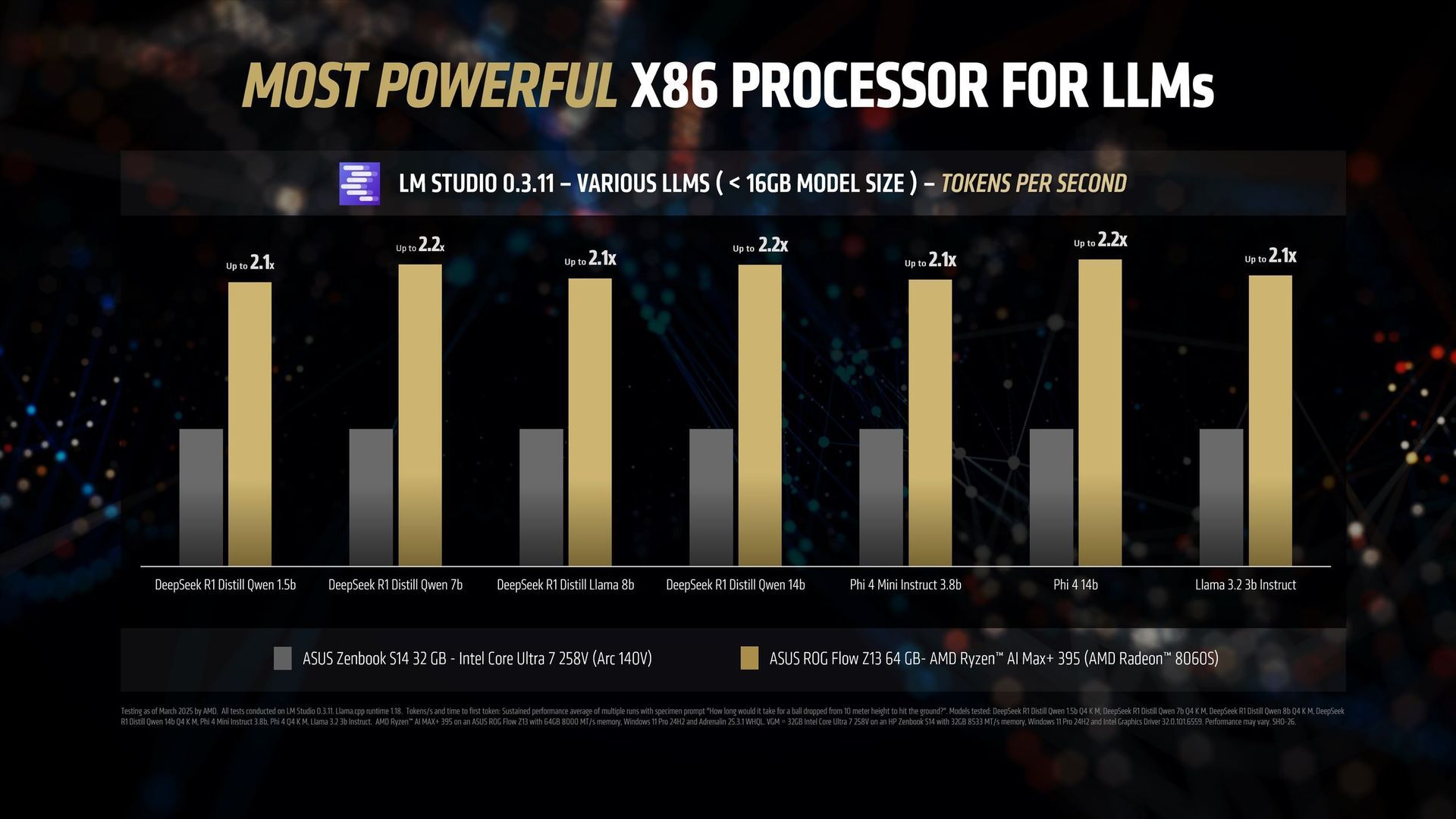
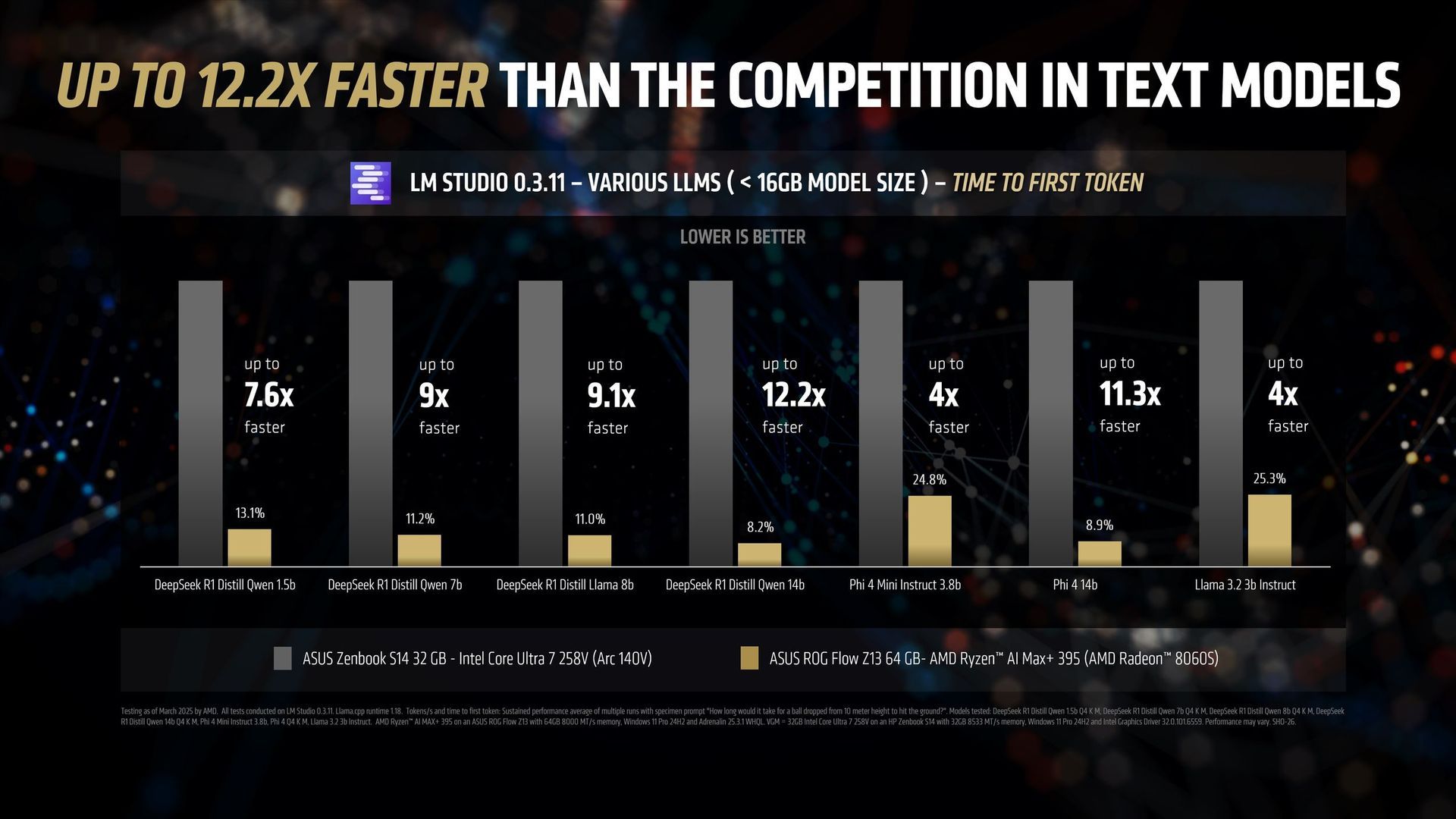
Specifically, the Ryzen AI Max+ 395 showed over twice the effective tokens per second when processing tasks with DeepSeek R1, Phi 4 Mini Instruct, and Llama 3.2 compared to its Intel competitor. The lead in performance becomes even more pronounced when analyzing ‘time to first token’ in text models, achieving speeds up to 12.2x faster in DeepSeek R1 Distill Qwen 14b and 11.3x faster in Phi 4 14b. In Llama 3.2 and other DeepSeek R1 distilled models, the processor’s performance varied between 4x to 9x faster compared to Intel.
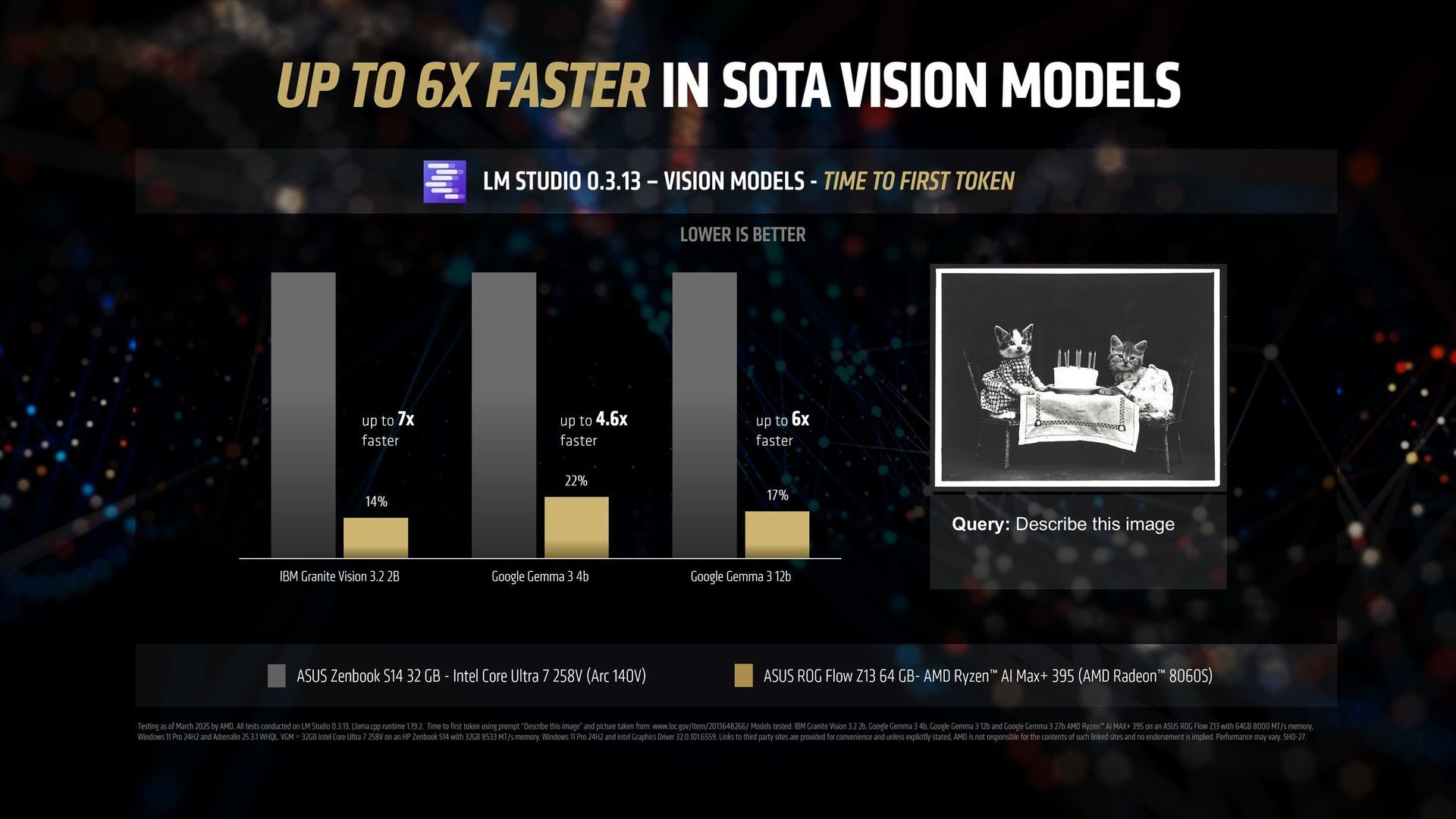
In terms of performance with vision models, it’s claimed that the Ryzen AI Max+ 395 is up to seven times faster in the time to first token, exemplified by its performance in IBM Granite Vision 3.2 2B. Comparatively, it is six times faster in Google Gemma 3 12b, with the speed advantage roughly halving when comparing against Gema 3 4b.
Comparative analysis with Intel’s APU
The AMD Ryzen AI Max+ 395 significantly surpasses the Intel Core Ultra 7 processor, which is designed for lower threshold AI computing. The Intel Core Ultra 7 258V features eight cores and eight threads, a maximum boost clock of 4.8 GHz, and a maximum TDP of 37W. In contrast, the Ryzen AI Max+ 395 boasts 16 cores, 32 threads, a boost clock of up to 5.1 GHz, and a default TDP of 55W, configurable up to 120W. This stark hardware difference contributes to AMD’s superior performance.
The benchmarks also highlight the differences between the two tested machines: the Asus ROG Flow Z13 and the midrange Asus Zenbook S14. The latter received a four-star review for its performance with the Lunar Lake processor, which launched in September 2024, while the AMD Ryzen AI Max+ 395 was recently introduced this month.
Additionally, the Ryzen AI Max+ 395 chipset is being utilized beyond AI laptops, as various mini PCs now incorporate this hardware for productivity and gaming applications. Companies such as GMKTec and Aoostar are pursuing the development of powerful AI mini PCs, targeting launches between mid-March and mid-May.
Featured image credit: AMD