
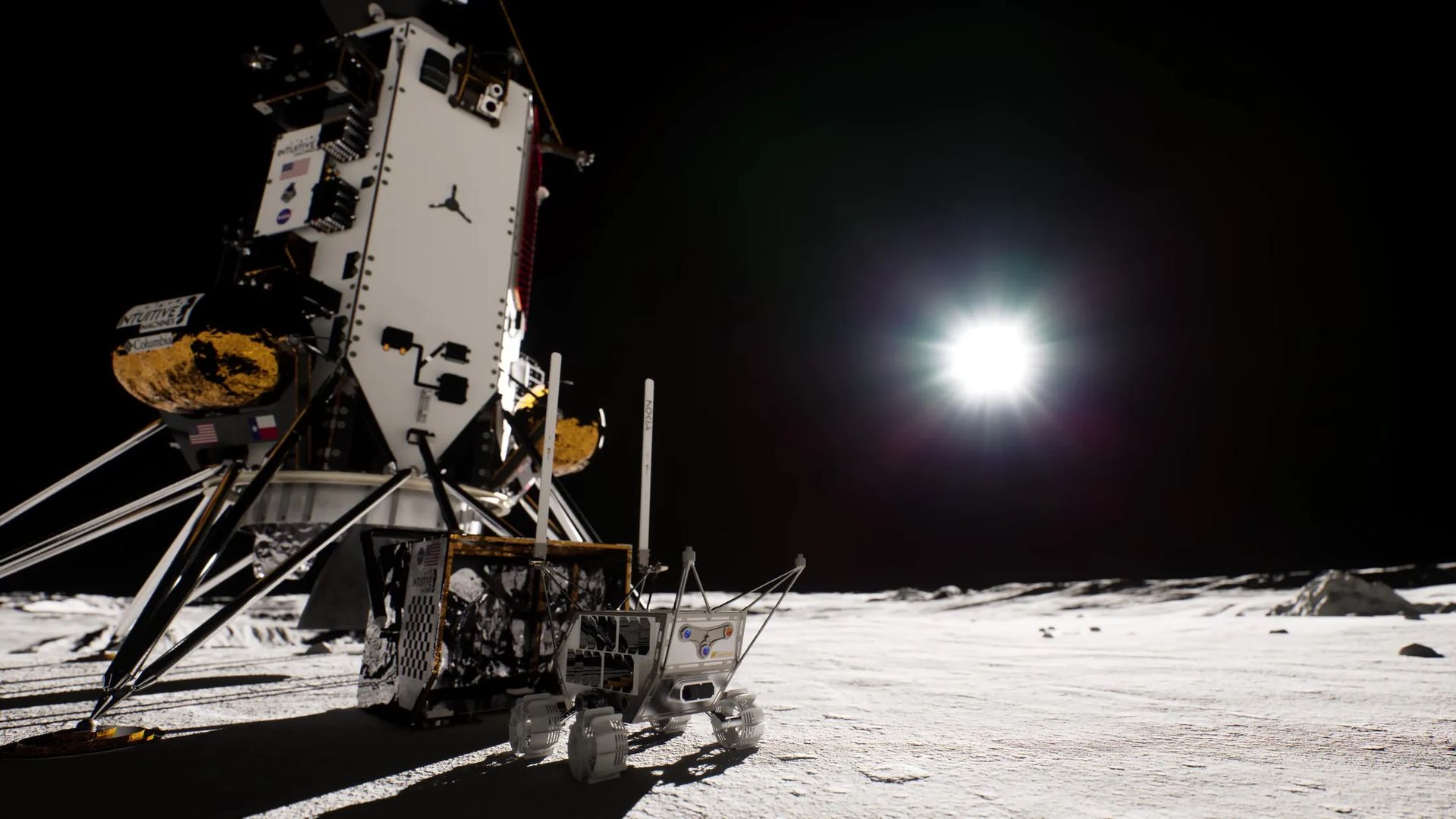

Nokia attempted to establish the first 4G LTE network on the Moon as part of the IM-2 mission, which launched on February 26, 2025. A lander named Athena was meant to deploy this network to facilitate communications for various lunar rovers, according to Wired.
Mission details and challenges
The IM-2 mission aimed to integrate Nokia’s Lunar Surface Communication System near Shackleton Crater, a scientifically significant area for the search for water and ice. However, Athena landed on its side, 250 meters from its intended site, due to the orientation of its solar panels, the sun’s direction, and cold temperatures in the crater.
The company announced on March 7, 2025, that it had to quickly conclude the mission as the lander could not recharge. Although the lander suffered this setback, Nokia still claims it “delivered the first cellular network to the moon” by validating key aspects of the network’s operation. Inside Athena, the Network in a Box (NIB) was equipped with a radio, base station, routing, and core components integrated into a compact system.
Video: Nokia (via Wired)
Nokia successfully powered up the NIB, which received commands and transmitted data to Intuitive Machines’ ground station on Earth, although it was online for only about 25 minutes before losing power. The mission had planned for a historic first cellular call on the moon, but the rovers intended for deployment were not released.
Rover deployment plans
After landing and system checks, Athena’s garage door was to open, releasing several onboard vehicles. These rovers were designed to connect to the 4G network, enabling them to transmit data. The Micro Nova Hopper, nicknamed Grace, was intended to hop into a permanently shadowed lunar crater to gather pictures and readings for signs of water ice, with collected data sent back to the NIB and then to Earth via satellite uplink.
Dow mentioned the rovers were expected to operate within 2 kilometers (approximately 1.2 miles) of Athena, which is the network’s supported range. Command data from mission controllers in Colorado would have traveled through Intuitive Machine’s direct-to-Earth transmission service to the lander and distributed via the 4G network.
The project reflects the increasing importance of the Moon in space exploration, especially in preparations for Mars missions. Nokia’s technology aims to enable more sustained lunar missions than those of the Apollo program, with intentions for semipermanent bases, scientific experiments, mining, and resource utilization being explored.
Advanced communication systems are crucial for the success of these missions, facilitating complex operations and collaboration. Thierry E. Klein, Vice President of Strategic Partnerships at Nokia Bell Labs, emphasized that the telecom industry’s expertise opens possibilities for space exploration.
Klein noted that the IM-2 mission is a technology demonstration, showcasing that telecom technology can be effectively operated in extreme environments like the Moon. Nokia optimized the NIB for space travel by reducing component size, weight, and power consumption, although the equipment was not expected to survive the lunar night.
Technical considerations
Nokia addressed several challenges, including thermal management during the lunar day and exposure to radiation. While not all components were fully radiation-hardened, Nokia implemented shielding strategies and reliability measures. The equipment underwent extensive mechanical testing to withstand launch and landing stresses.
To simulate lunar conditions, Nokia conducted test runs in volcanic landscapes in Fuerteventura, Canary Islands, and Colorado mountains. These tests aimed to improve predictions for network performance on the lunar surface.
Klein highlighted the importance of establishing robust communication infrastructure, which could support infrastructure development as lunar travel increases. The goal is to implement a system where future missions do not require bringing a network; only the devices would need to be transported.
Integrated communications for astronauts
The 4G LTE communications system is set to be integrated into Axiom Space’s future astronaut spacesuits, facilitating communication between astronauts and lunar landers. This system will enable real-time HD video streams and telemetry data transfer, resembling hands-free driving in a vehicle, as described by Russell Ralston, Axiom Space’s Executive Vice President of Extravehicular Activity.
Nokia chose to develop a 4G system rather than 5G to start with proven technology, as stated by Dow. He also indicated ongoing work on the evolution to 5G and noted an expected multi-vendor environment for lunar communications.
Michael López-Alegría, Chief Astronaut at Axiom Space, remarked that the capability to send HD video from the Moon to experts on Earth represents a significant advancement over Apollo-era training methods, transforming how astronauts can learn and guide their operations.
The IM-2 mission was the only planned test of Nokia’s lunar 4G network, which concluded prematurely. Dow mentioned that the company will continue to conduct Earth-based tests ahead of NASA’s Artemis III mission.
Featured image credit: Nokia (via Wired)


